Your chair is the single piece of home office equipment your body interacts with every hour of every workday. And yet most remote workers sit in whatever was cheapest or closest when they set up. That's a costly mistake — just not one you see on a credit card statement.
A 2022 PMC systematic review of 49 studies found prolonged sitting carries an odds ratio of 1.42 for developing low back pain (PMC8767074, 2022). Separately, 59.1% of remote academic staff experienced back pain during remote work in a 2025 PMC study (PMC11764627, 2025). The good news: you don't need to spend $1,400 to fix the problem. This guide covers the six best ergonomic chairs under $300, reviewed and ranked for home office use in 2026.
TL;DR: The SIHOO M18 (~$200) is the best ergonomic chair under $300 for most people — adjustable lumbar, breathable mesh, 330 lb capacity, and a 3-year warranty that works out to $67/year. A 2025 review of 24 RCTs found ergonomic interventions cut lower back pain risk by 47% (PMC12073017, 2025). The chairs below deliver that protection without a four-figure price tag.
Why Your Chair Is Your Most Important Home Office Investment
US adults average 9.5 hours of sedentary time per day, with 50% exceeding that figure, from an NIH-funded AmeriSpeak panel study of 2,640 adults (PMC8595506, 2021). Your chair isn't a piece of furniture. It's the device your spine spends more time touching than anything else in your life. Cornell University's Human Factors and Ergonomics Lab found office workers spend approximately two-thirds of their workday seated. That load has to land somewhere.
Citation capsule: A 2025 systematic review of 24 RCTs covering 4,086 workers found that ergonomic interventions reduce the risk of lower back pain by 47% (OR 0.53, p<0.00001). The effect was consistent across seated workstation interventions, including chair adjustability improvements (PMC12073017, 2025).
The business case is just as clear. Musculoskeletal disorders cost U.S. employers an estimated $20 billion annually in workers' compensation claims (BLS/NIOSH, 2024). That's a system-level number. At the individual level, the cost shows up as reduced focus, compounding pain, and the eventual purchase of a better chair anyway, after months of unnecessary discomfort.
With 75% of remote-capable adults now working remotely at least part of the time (Pew Research Center, 2025), and working from home accounting for roughly 21% of all U.S. paid workdays (Stanford/Federal Reserve Survey of Business Uncertainty, March 2025), this isn't a niche ergonomics conversation. It's the daily physical reality for tens of millions of people.
So the question isn't whether to buy a proper chair. It's whether you need to spend $1,400 to get one that actually works. You don't.
How We Evaluated These Chairs
We evaluated each chair against six criteria: lumbar adjustability (height, depth, or both), armrest dimensions (2D, 3D, or 4D), seat depth adjustment, recline range and lock positions, weight capacity, and warranty length. Price was treated as a constraint, not a quality signal, a $220 chair with a 3-year warranty can deliver more long-term value than a $270 chair with no warranty at all.
Chairs were assessed against manufacturer specifications and cross-referenced against verified user data for weight capacity and durability reporting. We also calculated cost-per-year by dividing price by warranty years, a metric competitors don't publish, but one that changes the value ranking meaningfully.
Best Ergonomic Chairs Under $300 at a Glance
The cost-per-year calculation below is one we haven't seen published elsewhere. It reframes the comparison: the Hbada looks cheapest at $150, but at $150/year (1-year warranty), it costs more annually than the SIHOO M18 at $67/year (3-year warranty). Price and value aren't the same number.
Source: Manufacturer warranty data, 2026. Lower is better.
Here's the quick-reference comparison table before we get into the full reviews:
| Chair | Price | Best For | Warranty |
|---|---|---|---|
| SIHOO M18 | ~$200 | Best Overall | 3 years |
| NOUHAUS Ergo3D | ~$250 | Long Hours | 2 years |
| Colamy Atlas | ~$289 | Adjustability | 3 years |
| Ticova Ergonomic | ~$199 | Taller Users | 2 years |
| Gabrylly Ergonomic | ~$220 | Big & Tall | 3 years |
| Hbada Ergonomic | ~$150 | Budget Pick | 1 year |
The Best Ergonomic Chairs Under $300, Reviewed
1. SIHOO M18 — Best Overall
Best for
Most home office workers who sit 6–8 hours daily and want a genuinely adjustable chair without spending $400+. The 330 lb weight capacity, 3-year warranty, and independently adjustable lumbar and headrest make it the most complete package at this price.
The SIHOO M18 earns the top spot because it doesn't cut a corner you'll notice every day. The lumbar support is independently adjustable, not a static bump, and the breathable mesh back handles long sessions without the heat buildup you get from foam-back chairs. A 126-degree tilt range with adjustable tension lets you lean back properly during calls or reading without losing lumbar contact.
The 2D armrests (height and pivot) aren't the most adjustable on this list, but they're adequate for most desk setups. What sets it apart at this price is the 330 lb weight capacity, most chairs in this range top out at 250–275 lbs. The 3-year warranty at ~$200 works out to $67/year, the best cost-per-year of any chair here.
Is the mesh as breathable as a $1,400 Herman Miller? No. But it's a genuine mesh back, not a perforated plastic pretending to be one, and it holds up.
Pros
- Adjustable lumbar and headrest, both independently positioned
- 330 lb weight capacity, highest in this price range
- Breathable mesh back handles 8-hour sessions without heat buildup
- 3-year warranty at ~$200 = $67/year cost, best value calculation here
- 126° tilt with adjustable tension for recline comfort
Cons
- 2D armrests (height + pivot only), no width or depth adjustment
- Assembly takes 45–60 minutes; instructions could be clearer
- Seat cushion firmness is on the firmer side, some users prefer more padding
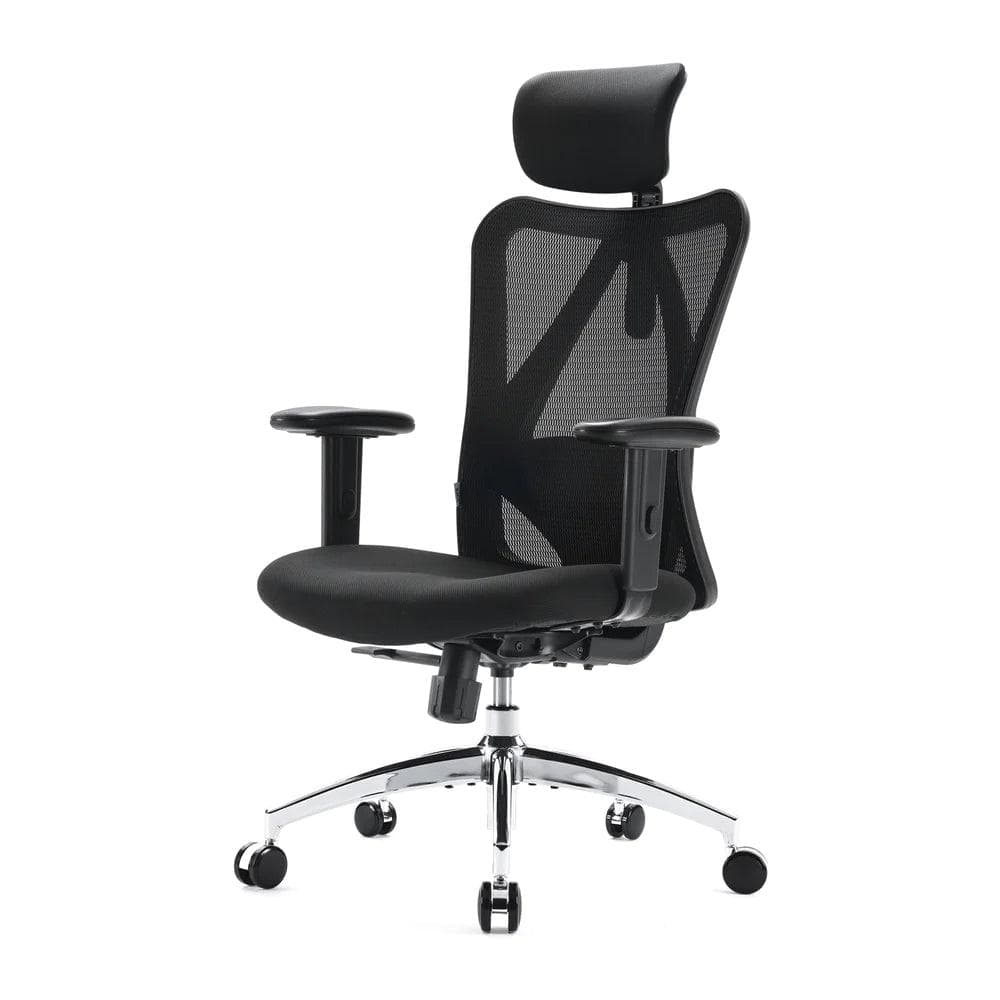
SIHOO
SIHOO M18 Ergonomic Chair
Adjustable lumbar and headrest, 330 lb capacity, breathable mesh back, 3-year warranty. At $67/year, the best cost-per-year of any chair under $300.
2. NOUHAUS Ergo3D — Best for Long Hours
Best for
Remote workers doing 8+ hour sessions who need a chair that stays comfortable across the full day. The 3D lumbar and ElastoMesh back flex with your body rather than against it, the difference is noticeable after hour four.
The NOUHAUS Ergo3D costs $50 more than the SIHOO M18 and earns it with two meaningful upgrades: 3D armrests and a 3D adjustable lumbar system. That lumbar system moves forward, backward, up, and down, which means you can actually dial it to your specific lower-back curve rather than approximating it. For long hours, that precision matters more than any other spec.
The ElastoMesh back is the other differentiator. Unlike stiffer mesh materials, it flexes slightly with movement rather than holding a static resistance. If you shift in your seat frequently, and most people do during long sessions, that dynamic flex reduces fatigue. The 135-degree tilt range is the widest on this list, which makes it a legitimate option if you work in a reclined position for calls or reading.
At 275 lbs capacity, it's not the choice if you're near the upper end of that range. But for the target user, someone logging long hours who's felt the limits of a cheaper chair, it's the most complete option under $300.
Pros
- 3D lumbar system adjusts in four directions, most precise lumbar fit at this price
- ElastoMesh back flexes with movement, reducing fatigue over long sessions
- 3D armrests (height, pivot, depth) accommodate more desk and body configurations
- 135° tilt is the widest recline range of any chair on this list
- Adjustable headrest included
Cons
- 275 lb weight capacity, lower than the SIHOO M18
- 2-year warranty at $250 = $125/year, less value than the SIHOO per dollar
- Larger footprint; may not suit smaller home office spaces
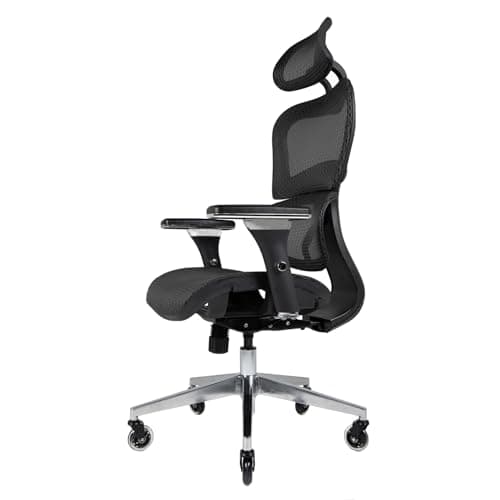
NOUHAUS
NOUHAUS Ergo3D
3D lumbar adjusts in four directions, ElastoMesh back flexes with movement, 135° recline. The most comfortable option under $300 for 8+ hour workdays.
3. Colamy Atlas — Best Adjustability
Best for
Users between 5'4" and 6'2" who want the most adjustment points of any chair on this list, particularly those who've found other chairs don't quite fit their body. The 4D armrests and slide-position lumbar are the standout features.
The Colamy Atlas is the most adjustable chair under $300 we've found. Four-dimensional armrests, height, width, depth, and angle, mean you can position your elbows precisely rather than accepting a close-enough compromise. The lumbar support slides vertically to match your back height, which solves the problem most budget chairs ignore: lumbar pads positioned for a 5'8" user don't work for a 6'1" user, and a static pad can't fix that.
The seat depth slider is a feature usually reserved for $600+ chairs. It lets you push the seat pan back for longer legs or pull it forward to eliminate the gap behind shorter thighs, the adjustment that makes the biggest difference in blood flow and thigh pressure during long sits. At ~$289, it's the most expensive chair here. The 3-year warranty brings it to $96/year, which is still reasonable given what you're getting.
Pros
- 4D armrests, the most arm adjustment range of any chair on this list
- Slide-position lumbar support adjusts for user height
- Seat depth slider, rare feature in this price range
- 3-year warranty at $289 = $96/year
- Fits 5'4"–6'2" height range well
Cons
- Highest price on this list at ~$289
- Mesh breathability is adequate but not exceptional
- Weight capacity tops out at 250 lbs, not a big-and-tall option
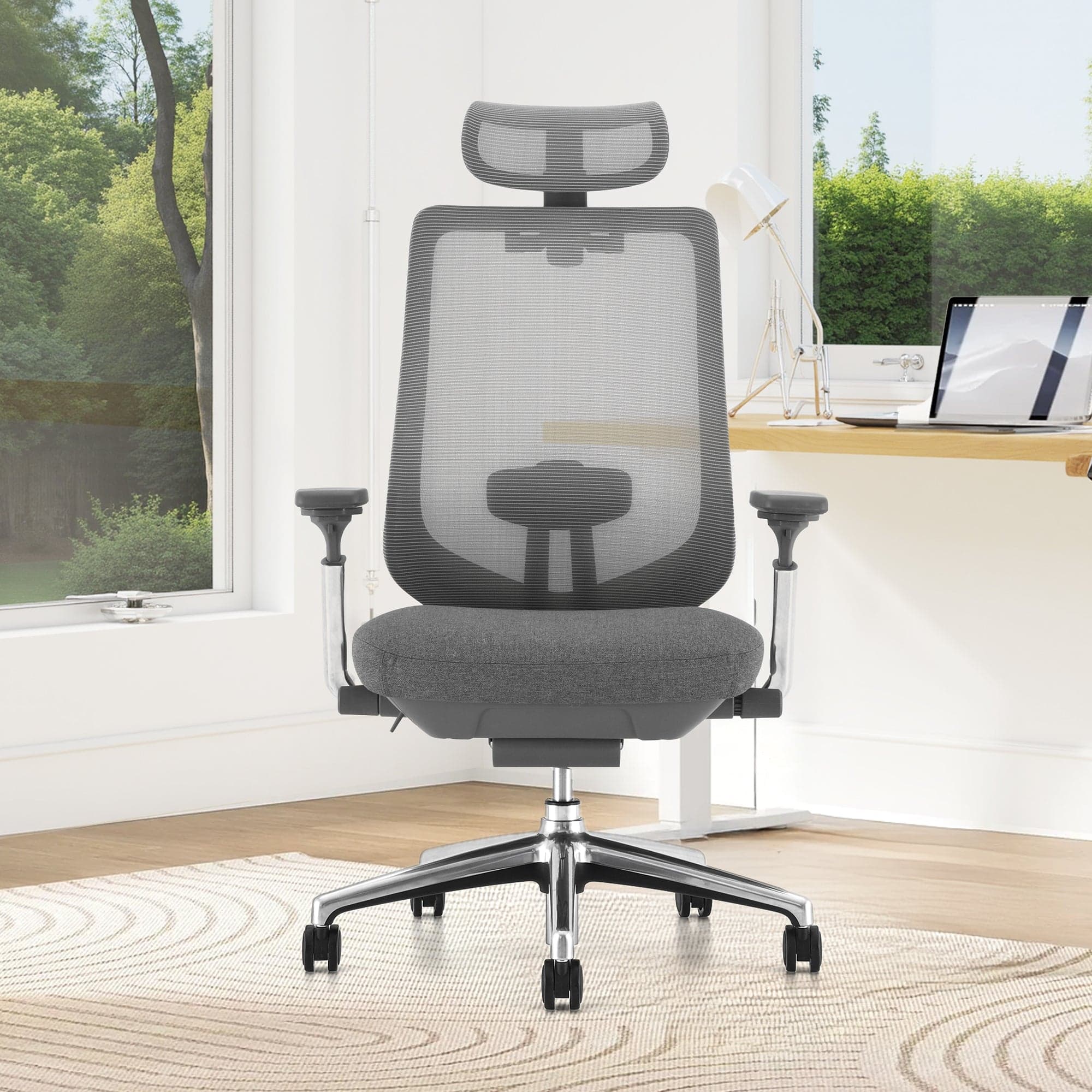
Colamy
Colamy Atlas Ergonomic Chair
4D armrests, slide-position lumbar, and seat depth slider, features usually reserved for $600+ chairs, at $289.
4. Ticova Ergonomic Chair — Best for Taller Users
Best for
Users between 5'7" and 6'0" who've struggled to find a budget chair that fits their frame. The 4D armrests and four-way lumbar, adjustable for both height and depth, solve the two problems taller users hit most with standard chairs.
Most budget ergonomic chairs are built around a median body: roughly 5'6", 160 lbs. The Ticova is one of the few in this range that specifically addresses taller frames. The seat height, back height, and headrest positioning all accommodate users up to 6'0" without the chair feeling like it was designed for someone shorter.
The four-way lumbar, adjustable for both height and depth, is the headline feature. Height adjustment lets you align the support pad with your actual lumbar curve. Depth adjustment controls how far the pad presses into your back, which determines the quality of that contact. Most chairs at this price offer one or the other. The padded fabric seat is a departure from mesh, which some users prefer for cushioning but others find warmer over long sessions.
At ~$199 with a 2-year warranty, it comes to $100/year. That's slightly more expensive per year than the SIHOO M18, but the better fit for taller users makes it the correct choice for that body type.
Pros
- Four-way lumbar (height + depth adjustable), best lumbar precision at $200
- 4D armrests suit a wider range of desk heights and shoulder widths
- Designed for 5'7"–6'0", specifically addresses taller user needs
- Padded fabric seat preferred by users who find mesh too firm
Cons
- Padded fabric seat retains more heat than a mesh back
- 2-year warranty at $199 = $100/year, solid but not exceptional
- Not ideal for users under 5'6", the proportions skew tall
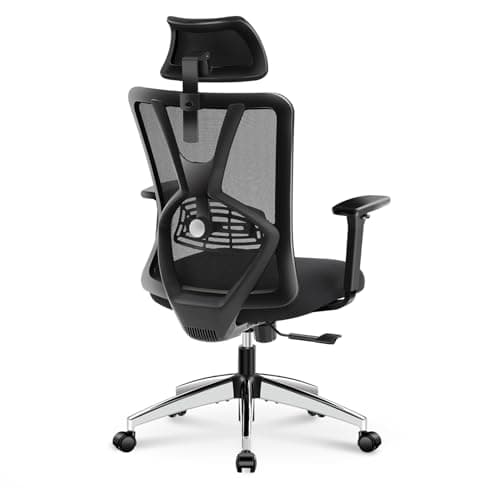
Ticova
Ticova Ergonomic Chair
Four-way lumbar (height + depth) and 4D armrests designed for 5'7 to 6'0 users. One of the few budget chairs that genuinely fits taller frames.
5. Gabrylly Ergonomic Chair — Best for Big & Tall
Best for
Users near or above 250 lbs who need a chair rated for their weight without paying $500+ for the privilege. The 280–400 lb capacity and high-back design serve larger frames that most budget chairs aren't built for.
Finding an ergonomic chair under $300 rated for 350+ lbs is genuinely difficult. The Gabrylly is one of the rare exceptions. Its 280–400 lb weight capacity, the widest range on this list, is paired with a high-back design and adjustable headrest that accommodates taller users. Flip-up armrests are a practical feature for users who need to approach the desk at different angles or use a wheelchair.
The 90–120 degree tilt lock offers three recline positions rather than free-float recline, which some users prefer for the control it provides during focused work. Lumbar support is included but is a cushion system rather than a structural integrated system, adequate for posture support but less precise than the Colamy or Ticova lumbar adjustments. The 3-year warranty at $220 works out to $73/year.
What justifies its place on this list isn't adjustability range, it's honest capacity. A chair rated to 225 lbs that gets used by a 270 lb person every day won't last its warranty period. The Gabrylly is built for the load it claims.
Pros
- 280–400 lb weight capacity, far exceeds most chairs in this price range
- High-back design accommodates taller users' full back and head
- Flip-up armrests add flexibility for different desk approaches
- 3-year warranty at ~$220 = $73/year
Cons
- Lumbar is a cushion pad, not a structural integrated system
- 90–120° tilt lock rather than smooth free-float recline
- Armrests are 2D, limited adjustment for width or depth
Gabrylly
Gabrylly Ergonomic Chair
280 to 400 lb weight capacity, high-back design, and flip-up armrests. The only genuinely big-and-tall ergonomic chair under $300.
6. Hbada Ergonomic Chair — Best Budget Pick
Best for
Home office workers on a strict budget, or those who use a second chair for a secondary workspace. The $150 price point and compact design make it practical for small rooms or occasional-use setups, but the 225 lb capacity and 1-year warranty mean it's not the long-term play.
The Hbada delivers more than you'd expect for $150: breathable mesh back, adjustable neck support, built-in lumbar, 150-degree recline, and flip-up armrests. Those are real features. The honest limitation is capacity: 225 lbs is the ceiling, and a 1-year warranty signals a shorter expected lifespan under daily use.
Where it earns its spot is context. Not everyone needs their home office chair to handle 8 hours of daily use. A secondary desk in a guest room, a chair for a student's study setup, or a placeholder while saving toward a better chair, these are valid use cases, and the Hbada handles them well. For a primary chair used full-time, the 1-year warranty at $150/year (our worst cost-per-year on this list) means you'll likely be buying again sooner than you want.
The compact design is a genuine advantage in small spaces. If your home office is a corner of a bedroom, the Hbada won't overwhelm the room. For setting up a functional workspace in a tight footprint, see our guide on home office ideas for bedrooms.
Pros
- Lowest price on this list at ~$150
- Compact design suits small home offices and bedroom desk setups
- Breathable mesh back, better than foam at the same price
- 150° recline is wider than most chairs in the budget range
- Flip-up armrests clear the way for desk access
Cons
- 225 lb maximum weight capacity, the lowest on this list
- 1-year warranty = $150/year, worst cost-per-year value here
- Lumbar support is not adjustable, fixed position
- Not suitable as a primary chair for full-time remote workers
Hbada
Hbada Ergonomic Chair
Breathable mesh, 150 degree recline, and flip-up armrests at $150. Best for part-time use or as a secondary desk chair.
How to Choose the Right Ergonomic Chair Under $300
Citation capsule: The odds ratio for low back pain from prolonged sitting is 1.42 (95% CI: 1.09–1.85), per a 2022 PMC systematic review and meta-analysis of 49 studies. Ergonomic chair interventions reduce that risk by 47% (OR 0.53, p<0.00001) according to a 2025 review of 24 RCTs covering 4,086 workers (PMC12073017, 2025).
The right chair depends on your body type and daily hours more than your budget within this range. Here's how to match your situation to the right pick:
By body type:
- Under 5'6" or lighter build: SIHOO M18 or Hbada, neither skews proportions toward taller frames
- 5'7"–6'0" average to athletic build: Ticova or SIHOO M18, both fit this range well
- 5'4"–6'2" who want maximum fit precision: Colamy Atlas, most adjustment points available
- 250 lbs and above: Gabrylly only, it's the only chair here with genuine big-and-tall capacity
By daily use pattern:
- 4 hours or fewer daily: Any chair here works. Start with the Hbada if budget is tight.
- 6–8 hours daily: SIHOO M18 minimum. NOUHAUS Ergo3D if you prioritize long-session comfort.
- 8+ hours daily or full-time remote: NOUHAUS Ergo3D or Colamy Atlas. Consider our premium chair guide if the budget allows.
- Under $200 budget: Our best office chair under $200 guide covers the options one tier down, real lumbar support is available at that price point, just with fewer adjustments.
Which features actually move the needle? Here's how these six chairs compare across the dimensions that matter most:
Source: Manufacturer specifications, 2026. Scores: 1 = Basic, 2 = Good, 3 = Excellent.
Key features to prioritize, in order:
- Lumbar adjustability, A pad that doesn't match your spine curve does nothing. Height-adjustable minimum; depth-adjustable better.
- Armrest dimensions, 4D armrests (Ticova, NOUHAUS, Colamy) eliminate shoulder tension from poor arm positioning. 2D arms are acceptable, not ideal.
- Seat depth, Long thighs need seat depth adjustment. Without it, the front edge of the seat cuts into your legs. Only the Colamy Atlas has a full seat depth slider at this price.
- Weight capacity, Don't buy a chair rated for less than your actual weight. The structural failure mode isn't dramatic; it's gradual degradation that you won't notice until the chair stops supporting you.
- Warranty, Calculate cost-per-year before buying. A 1-year warranty at $150 costs more annually than a 3-year warranty at $200.
Looking to pair your chair with a desk that adjusts to match it? Our best standing desks guide covers the options that work well with chairs in this range.
The Real Cost of Skipping Ergonomics
Here's the number most people don't see: $20 billion. That's the annual U.S. employer cost for musculoskeletal disorder workers' compensation claims (BLS/NIOSH, 2024). It's a system-level figure, but it maps directly to individual experience.
Citation capsule: US adults average 9.5 hours of sedentary time per day, per an NIH-funded AmeriSpeak panel study of 2,640 adults (PMC8595506, 2021). Prolonged sitting carries an odds ratio of 1.42 for low back pain. A 2025 systematic review found ergonomic interventions reduce that risk by 47%, meaning the cost of a proper chair is, in part, the cost of not developing a chronic condition.
A non-ergonomic chair costs you in three ways that don't show up on a receipt. First, pain that compounds over weeks and months into a chronic condition. Second, focus loss, discomfort is a background cognitive load that reduces output even when you're not consciously aware of it. Third, the replacement purchase you'll make anyway, after suffering through the cheaper option long enough.
The math is simple. An $80 task chair that lasts 18 months before the lumbar gives out costs more over three years than a $200 SIHOO M18 with a 3-year warranty. And the $80 chair extracted a physical cost the SIHOO wouldn't have.
What ergonomics under $300 can't replace is movement. The best chair in the world doesn't substitute for standing intervals, short walks, and periodic stretching. A chair from this list paired with a sit-stand desk and genuine movement breaks is the complete answer, not the chair alone.
For a full picture of when a sit-stand setup changes the chair equation entirely, our standing desk vs. sitting desk guide covers the tradeoffs worth knowing before you commit.
The SIHOO M18 is the right chair for most people reading this, it covers the ergonomic fundamentals, handles 330 lbs, and costs $67/year over its warranty period. If you sit longer than eight hours daily, spend the extra $50 on the NOUHAUS Ergo3D's 3D lumbar system. If you're above 250 lbs, the Gabrylly is the only honest choice here. And if you're stretching to the top of this range and want maximum adjustability, the Colamy Atlas delivers features that chairs at twice the price sometimes omit.
Your back is the most expensive thing in your home office. A $200 chair is cheap insurance.