Only 19% of remote workers have a dedicated study or office room, according to a 2023 study of 1,766 homeworkers published in the International Journal of Environmental Research and Public Health (PMC/IJERPH, Feb 2023). The other 81% are working in living rooms, bedrooms and kitchens. The average US apartment measures 908 square feet, with studios averaging 457 square feet (RentCafe/Yardi Matrix, Apr 2025). The real challenge here isn't square footage. It's shared space.
Working in a multi-use room creates pressure on every surface. The dining table doubles as a desk. The bedroom doubles as the office. When the workspace bleeds into the living space, both suffer. The 31 ideas below address that pressure directly, with specific products, dimensions and techniques that work in apartments, studios and compact homes.
TL;DR: A monitor arm, vertical storage and a defined floor zone solve the small office problem in almost any square footage. The monitor arm recovers 8-12 inches of desk depth. Vertical storage keeps the floor clear. A dedicated rug marks the work zone without permanent construction. Those three changes outperform any furniture purchase.
For specific product recommendations at each price point, the compact home office setup guide covers desks, chairs and gear bundles from $490.
Furniture and Layout (Ideas 1-8)
As of August 2025, 22.1% of employed Americans telework (Bureau of Labor Statistics via Gable, Aug 2025). Most of them work on furniture that wasn't designed for a workday. Oversized desks dominate small rooms visually and crowd out everything else. The fix is right-sized furniture at the right scale for the actual space.
Idea 1: Wall-mounted fold-down desk
A fold-down desk has zero floor footprint when closed. It reads as a framed panel on the wall. Open, it gives a full working surface 18-24 inches deep. Murphy desk kits add concealed storage behind the panel surface, so cables and accessories disappear at the end of the day.
Idea 2: Corner desk
A corner desk uses dead-corner space that would otherwise sit empty. The L-shape creates two distinct zones without surfaces overlapping. Add a monitor arm to the corner post and both sides stay completely clear for actual work.
Idea 3: Compact desk under 48 inches
A 40-48 inch desk fits a single monitor on an arm, a keyboard and a mouse with room left over. The IKEA MICKE 41-inch ($79.99) is 19.6 inches deep, which works with an arm even in very shallow alcoves. See the full breakdown in the small desk ideas guide.
Idea 4: Standing desk for posture flexibility
A compact electric standing desk in the 40-48 inch range enables sit-stand alternation without requiring a large footprint. The Fezibo 40-inch at $169-$219 fits in spaces where a full 60-inch desk would dominate the room. The best standing desks guide covers compact options with narrow frames.
Idea 5: Cloffice (closet office)
A standard reach-in closet is roughly 24 inches deep and 36-60 inches wide. That's enough for a desk shelf, a monitor on a wall-mounted arm and a task light. Remove the hanging rod, add a desk surface at sitting or standing height, and close the doors after work. The workspace disappears completely.
Idea 6: Bedroom desk nook
A corner of a bedroom handles a compact desk without disrupting sleep, provided you add a visual separator. A curtain on a tension rod, a tall bookshelf or a cluster of plants creates a soft boundary between sleep and work zones. The bedroom office ideas guide covers the layout options in detail.
Idea 7: Window nook desk
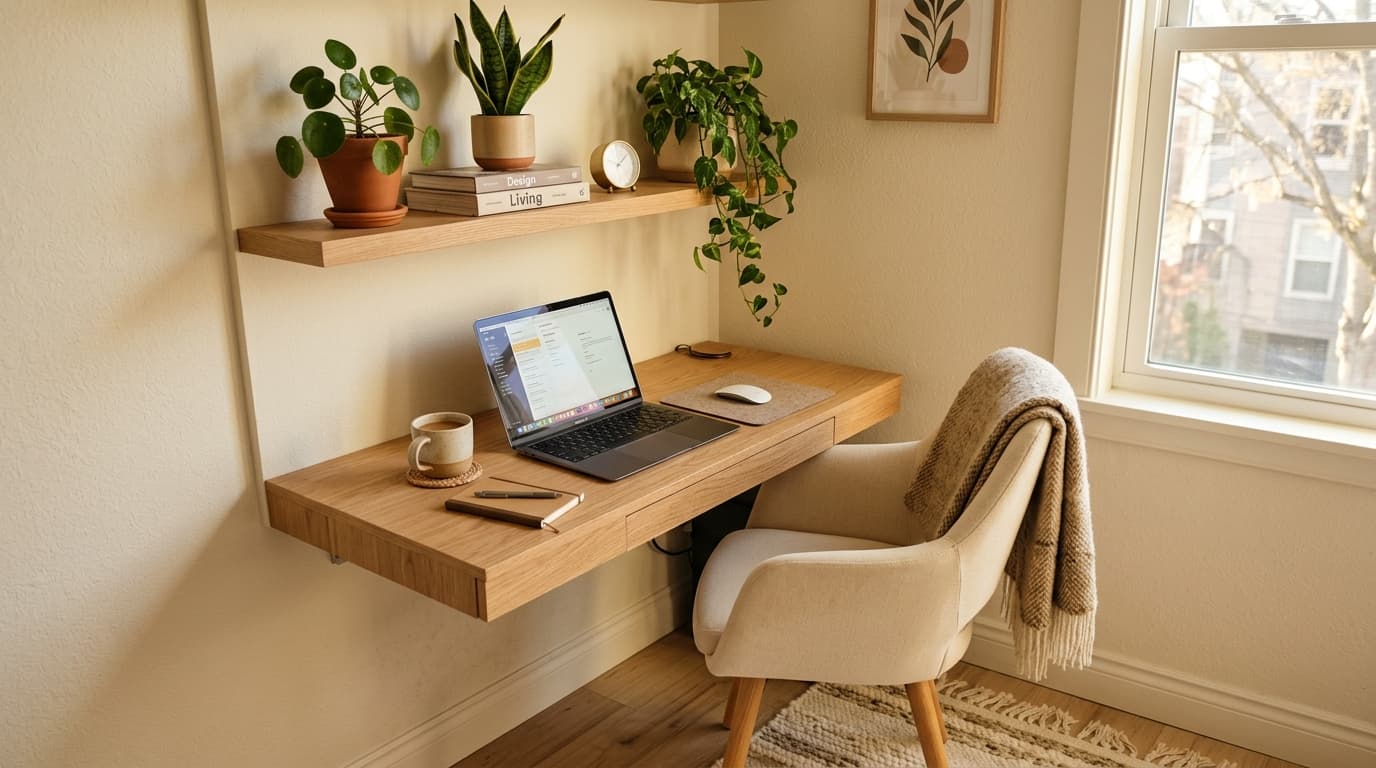
A shallow desk placed in front of a window uses natural light as the primary source and occupies space that's typically underused. Keep the window sill clear. Objects on sills block light and make the room feel smaller than it is.
Idea 8: Under-stairs workspace
Under-stair space is often the only zone in a home where a small desk sits without taking floor area from any functional living room. The sloped ceiling limits height, so a wall-mounted or low-profile monitor arm is necessary. A wall-mounted lamp on a swing arm handles task lighting without requiring a surface to stand on.
Monitor and Display Setup (Ideas 9-12)
The same 2023 IJERPH study found that 61.2% of homeworkers reported musculoskeletal discomfort, with neck pain the most common complaint at 50.4% (PMC/IJERPH, Feb 2023). Most of that neck strain comes from screens at the wrong height. In a small office, the monitor setup is also the biggest driver of desk clutter. Solving both problems at once is the highest-leverage move in any small workspace.
The monitor arms guide covers five options from $35 to $400.
Idea 9: Monitor arm (highest-impact single upgrade)
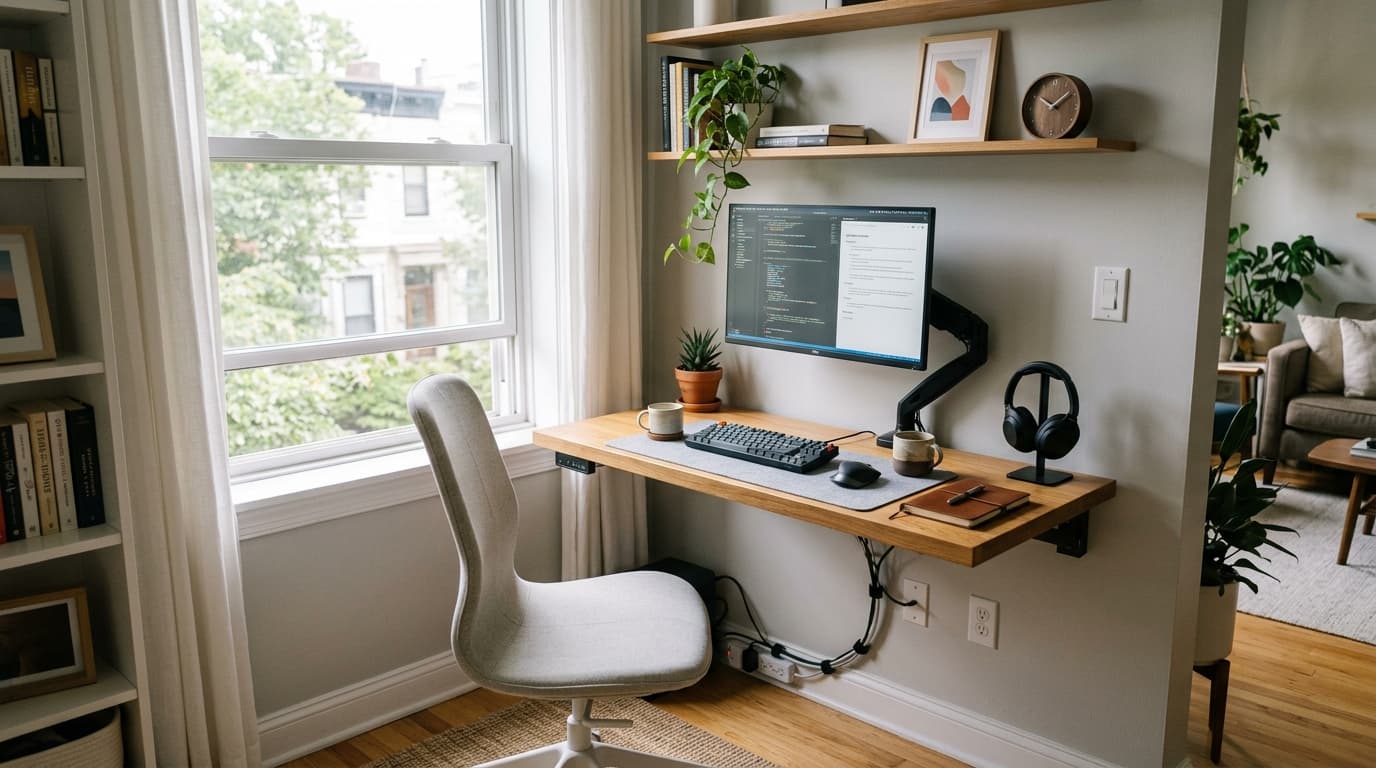
A monitor arm replaces the stand, recovers 8-12 inches of desk depth and positions the screen at OSHA-recommended eye level. The Ergotron LX at $150 is the gas-spring standard for single-display setups. One product change transforms how much usable surface the desk actually has.
Idea 10: Laptop stand plus external keyboard
A laptop stand raises the screen to near-eye level without requiring an external monitor. The Rain Design mStand ($45) and the Nexstand K2 ($30) are the two practical options at different price points. Either one needs a separate Bluetooth or USB keyboard to complete the ergonomic setup.
Idea 11: Vertical monitor orientation
A monitor rotated 90 degrees to portrait orientation uses less horizontal desk width. For documents, email and code, portrait is often more useful than landscape. Most monitor arms support portrait pivot, so no additional hardware is needed.
Idea 12: Wall-mounted monitor
Wall mounting eliminates the desk footprint entirely. VESA-compatible wall mounts start at $15-$25. The constraint is that the desk and mount need to be on the same wall, and repositioning requires more effort than adjusting a desk-clamp arm.
Storage and Organization (Ideas 13-18)
Visual clutter makes small spaces feel smaller and increases cognitive load during focused work. The vertical storage principle applies to every small office: anything that doesn't need to be on the desk surface should be on the wall or in a drawer. Floor-standing storage is the first thing to eliminate.
The cable management guide covers trays, raceways and velcro systems by desk type.
Idea 13: Floating shelves above the desk
Two floating shelves at staggered heights above the desk replace floor-standing storage entirely. IKEA LACK shelves at $12-$20 each hold 22 lbs. Two shelves clear the desk surface of everything currently stacked on it and keep reference materials within reach.
Idea 14: Pegboard wall organizer
An IKEA SKADIS pegboard ($23.99 for 22"x22") mounts on the wall above or beside the desk. Hooks, shelves and containers snap on without tools. Headphones, cables, scissors and notebooks move off the desk surface and stay in reach without clutter.
Idea 15: Under-desk cable management
A cable tray mounted under the desk holds the power strip and adapter bricks off the floor. Velcro straps bundle cables into a single run along the desk edge. The visual result is a desk that looks organized even in a shared space where the workspace is always in view. The cable management guide covers tray and clip options.
Idea 16: Bookshelf room divider
A tall bookshelf placed perpendicular to the wall between the desk and the living area creates a visual boundary without permanent construction. Open shelves pass light through the gaps. You get storage on both sides and a workspace that feels separate, without a door or a wall.
Idea 17: Wall-mounted file organizer
A wall-mounted file sorter keeps documents off the desk surface. A three-slot letter sorter at $15-$25 handles current projects, reference materials and mail without requiring a file cabinet on the floor.
Idea 18: Rolling storage cart
The IKEA RASKOG cart at $19.99 parks next to the desk during work hours and rolls to a closet or under a counter after. It carries supplies and peripherals that don't need to live on the desk surface all day. No floor footprint when not in use.
Lighting (Ideas 19-22)
Task lighting and video call lighting are two different problems. Task lighting reduces eye strain and shadow during focused work. Call lighting ensures your face is legible on screen. Treating them as one problem produces a setup that solves neither. Each needs a dedicated solution, and in a small office, both solutions need a small footprint.
The desk lamp guide covers both task lamps and key lights by footprint and price.
Idea 19: Monitor light bar
A monitor-mounted light bar (BenQ ScreenBar, $109) clips to the top bezel and illuminates the desk without any surface footprint and without reflecting off the screen. The light source sits in front of you, not behind or beside you, which eliminates glare entirely.
Idea 20: Key light for video calls
A key light positioned 30-45 degrees in front of you at face level makes video calls look polished regardless of ambient conditions. The Elgato Key Light Neo at $149 is app-controlled. A ring light costs less but produces a less flattering circular catchlight in the eyes.
Idea 21: Bias lighting
LED strips running behind the monitor at roughly 10% of the screen's peak brightness reduce the perceived contrast between the screen and the surrounding wall. Warm strips at 3,000-4,000K work best for long sessions. Govee bias lighting strips start at $20-$30 and install with adhesive backing.
Idea 22: Daylight task lamp
A task lamp with a 5,000-6,500K daylight bulb on the non-dominant side of the desk reduces shadows and fatigue during focused work. Afternoon natural light shifts in color temperature. A daylight lamp compensates without requiring you to reposition. The desk lamp guide covers color temperature and CRI ratings in depth.
Acoustics and Focus (Ideas 23-26)
Open-plan apartments have no acoustic separation between work noise and background noise. Hard floors, bare walls and high ceilings create rooms where keyboard clicks echo and conversations carry. In a shared living space, audio control is as important as visual organization. Both affect productivity and the experience of everyone around you.
The noise-cancelling headphones guide compares the top options by ANC strength and call quality.
Idea 23: Over-ear noise-cancelling headphones
Noise-cancelling headphones solve the shared-space audio problem more reliably than room treatment alone. The Sony WH-1000XM5 at $280-$350 and the Bose QuietComfort 45 at $229 both block background sound effectively during calls and focus sessions. The noise-cancelling headphones guide compares the top options.
Idea 24: USB microphone for calls
A USB microphone at $60-$100, such as the Samson Q2U or Blue Snowball, is more intelligible than any laptop microphone in a reflective room. Clear audio on calls reduces listener fatigue for everyone participating, not just you. The USB microphone guide covers cardioid vs. omnidirectional pickup patterns.
Idea 25: Soft furnishings for absorption
Rugs, curtains and a cushioned chair absorb reflected sound. In a bare apartment, voices and keyboard clicks echo off every surface. A 5x7 rug under the desk, curtains on the nearest window and a chair cushion reduce room reverb noticeably without any acoustic treatment panels.
Idea 26: Room divider or curtain panel
A curtain panel hung from a ceiling-mounted track creates a soft acoustic and visual boundary between the workspace and the rest of the room. It's fully removable, requires no wall damage and draws back completely when not needed. The fabric itself absorbs some sound on its own.
Visual Design and Psychology (Ideas 27-31)
Stanford economist Nicholas Bloom's research found that structured home work environments correlate with a 13% productivity gain compared to unstructured setups (Stanford/QJE, 2015). A defined workspace isn't just aesthetic. It's functional. The zone tells your brain that work happens here, and rest happens elsewhere. In a small apartment, creating that zone requires intention, not square footage.
The work from home productivity guide covers the routine and habit side of the equation in depth.
Idea 27: Dedicated rug
A 5x7 rug under the desk defines the work zone with floor texture rather than walls or furniture. The physical boundary reinforces the mental transition between work mode and home mode. Low-pile rugs work best under rolling chair casters.
Idea 28: Desk pad
A leather or felt desk pad at $20-$60 defines the primary work surface visually and protects the desk from scratches. In a multi-use space like a dining table setup, the desk pad marks one area as the office zone without any permanent change to the surface.
Idea 29: Wall color or accent
A painted accent wall or a gallery of prints behind the desk makes the workspace feel intentional and distinct from the rest of the room. In a rental where painting isn't permitted, removable wallpaper panels at $30-$60 per panel achieve the same result with no permanent change.
Idea 30: Plant grouping
A cluster of two or three small plants at the corner of the desk or on a nearby shelf adds visual interest without any floor footprint. Snake plants, ZZ plants and pothos tolerate low-light conditions and require watering once a week or less. The home office plants guide covers low-maintenance species by light level.
Idea 31: End-of-day shutdown routine
When physical separation isn't possible, behavior fills the gap. A brief shutdown routine, closing all browser tabs, turning off the desk lamp, putting the laptop in a bag, signals the end of the workday more reliably than willpower alone. A short walk immediately after amplifies the transition between work mode and home mode.
Frequently Asked Questions
What is the minimum space needed for a home office?
A functional home office fits in roughly 4 ft x 4 ft. A wall-mounted fold-down desk with a compact task chair covers the basics. Add a monitor arm and a wall shelf above the desk, and you have a complete single-monitor setup with zero wasted floor space.
How do I make a small home office look bigger?
Use light wall colors, maximize natural light by keeping window sills clear, and store everything vertically. A monitor arm eliminates the stand footprint, floating shelves replace floor-standing storage, and a rug in a light tone makes the space read larger than it is.
What is the best desk for a small home office?
A compact desk between 40 and 48 inches wide paired with a monitor arm is the most efficient choice. The arm removes the monitor stand footprint, recovering 8-12 inches of usable desk depth. For the smallest spaces, a wall-mounted fold-down desk eliminates the footprint entirely when closed.
Can I set up a proper ergonomic workspace in a corner?
Yes. A corner desk, monitor arm and ergonomic chair with a narrow base cover the ergonomic fundamentals in a compact footprint. Position the monitor at eye level using the arm, keep keyboard and mouse at elbow height, and ensure the chair seat depth allows 2-3 finger clearance behind the knees.
How do I separate work and home life in a small apartment?
Physical and visual cues are the most reliable tools. A dedicated rug under the desk defines the work zone. A fold-down desk or retractable screen hides the workspace after hours. A brief shutdown routine, even just closing the laptop and turning off the desk lamp, reinforces the mental transition.
The monitor arm is the single highest-leverage upgrade in any small home office. It recovers surface depth, corrects screen height and eliminates the stand footprint in one move. Vertical storage and a defined floor zone do the rest. For a full ergonomic setup framework, the home office ergonomics guide covers posture, monitor height and chair fit in detail. For a curated product list built specifically for compact rooms, the small spaces product guide narrows the field to what actually fits.