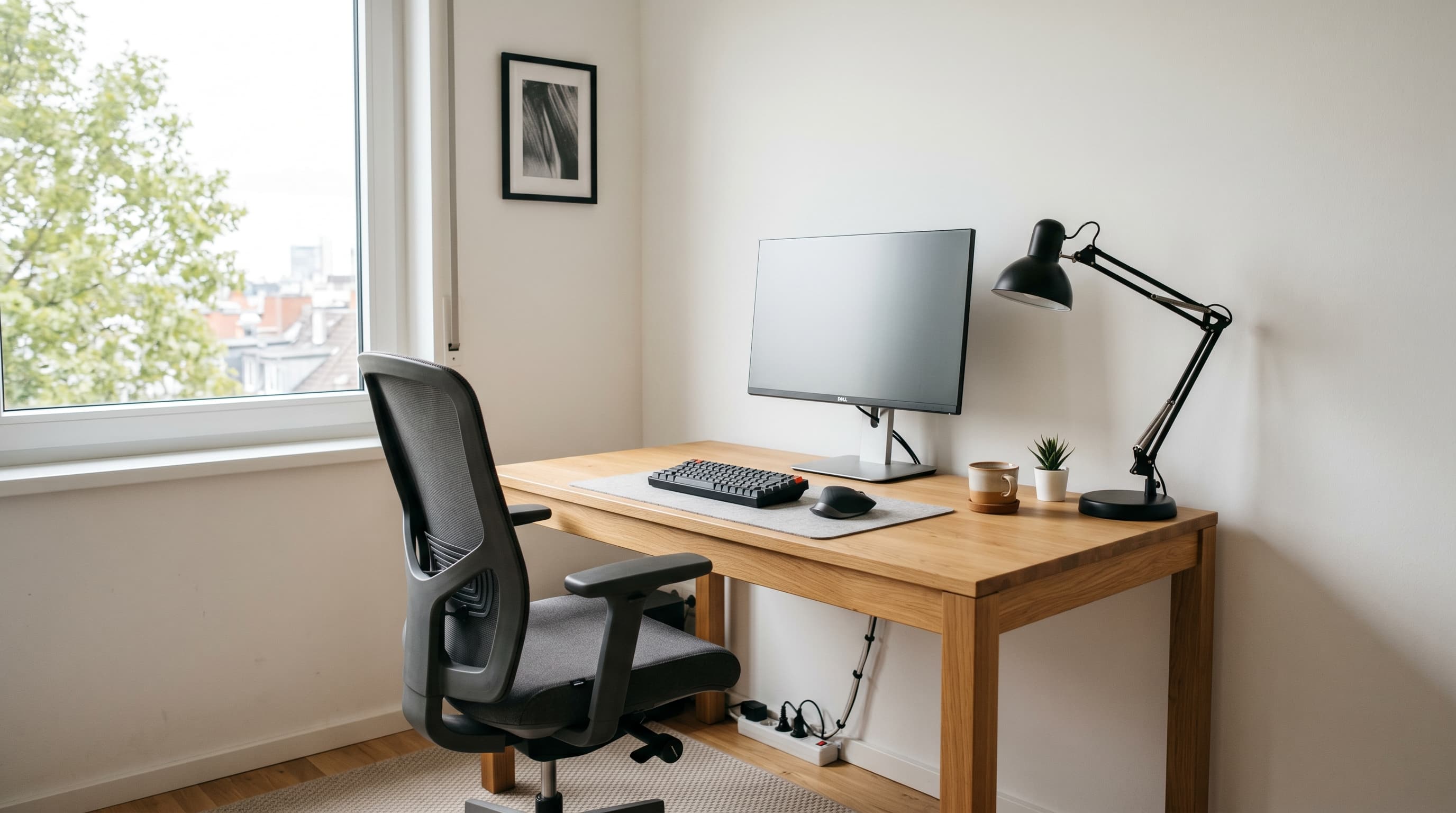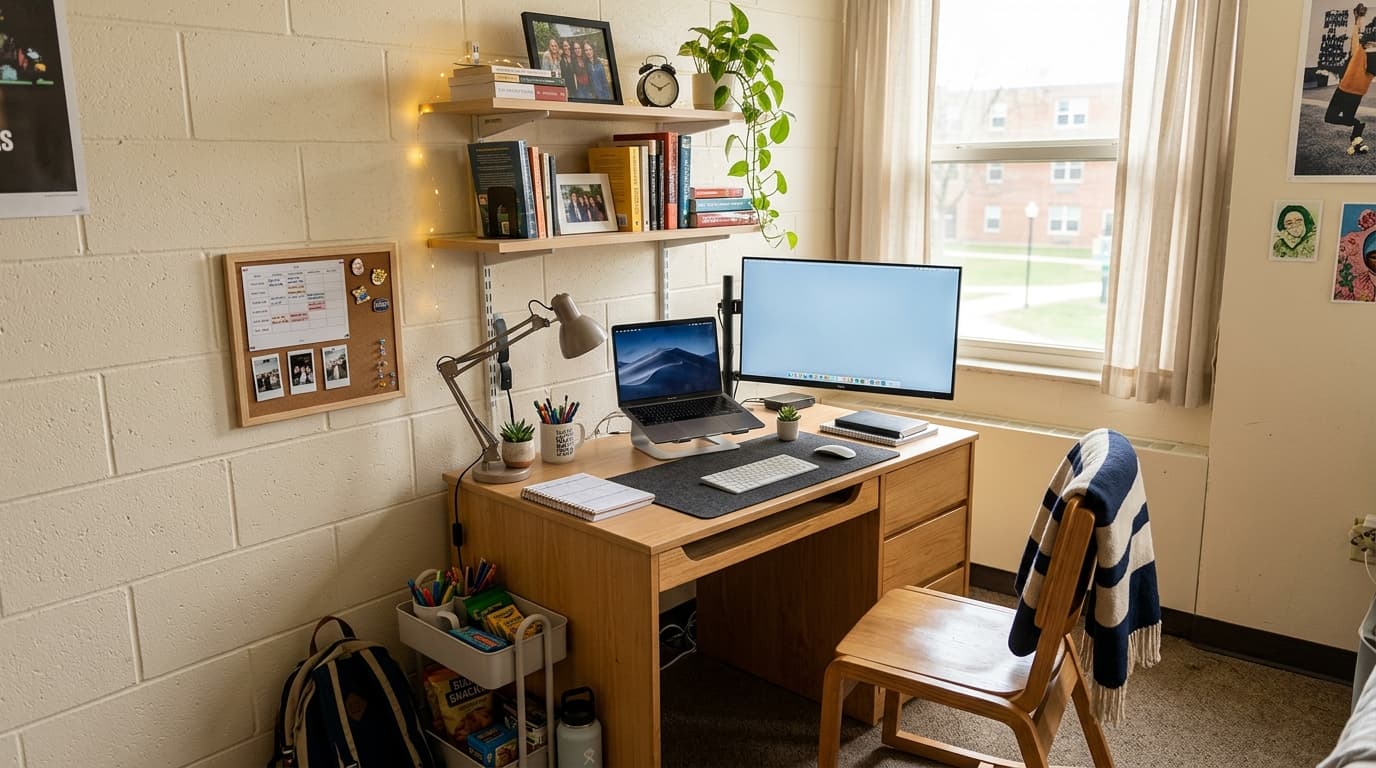
A lot of home office advice assumes you have a spare room. Most people don't.
According to a 2023 study published in the International Journal of Environmental Research and Public Health, 24.6% of remote workers use their bedroom as their primary workspace (PMC / IJERPH, 2023, n=232). That's not a niche situation — it's the reality for roughly one in four people working from home. The challenge isn't whether a bedroom office can work. It's setting one up so it actually does.
Done right, a bedroom home office lets you work comfortably without wrecking your sleep, even in a small space. This guide covers the ideas, the gear, and the habits that make it sustainable. If you're also weighing small home office ideas beyond the bedroom, that guide runs parallel to this one.
TL;DR: A bedroom office works if you physically separate the work zone from the bed, choose space-efficient furniture, and build a consistent shutdown ritual. The Sleep Foundation identifies stimulus control — your brain linking spaces with activities, as the primary reason bedroom work disrupts sleep. Get the separation right and the rest follows (Sleep Foundation, 2024).
The One Rule That Makes or Breaks a Bedroom Office
The single most important thing you can do for a bedroom office has nothing to do with furniture. The Sleep Foundation describes stimulus control as a clinically documented mechanism underlying insomnia, your brain forms strong associations between spaces and activities, and if it links your bedroom with work stress and screen time, falling asleep becomes genuinely harder (Sleep Foundation, 2024). That's the core risk, and it's the one you have to design around from the start.
In practice, the fix has to be physical. Keeping your desk in a corner on the opposite wall from your bed puts 8–12 feet between your work zone and your sleep zone. That distance matters, it creates a spatial cue your brain can actually use. A room divider, a tall bookshelf, or even a curtain hung on a tension rod can reinforce that boundary if the room is large enough. The goal: when you're in bed, you can't see your screen, your keyboard, or your open notebook.
What doesn't work: working from your bed. I know it feels comfortable, and I've done it myself on lazy mornings. But it trains your brain to treat the bed as a work surface, which is the exact association you're trying to prevent. Even a small dedicated desk is better.
Citation capsule: A 2023 study of 232 remote workers found that 24.6% used their bedroom as their primary workspace. Sleep researchers identify stimulus control, the brain's tendency to associate environments with specific activities, as the primary mechanism by which bedroom work disrupts sleep quality. Physical separation between desk and bed is the evidence-based mitigation (PMC / IJERPH, 2023; Sleep Foundation, 2024).
4 Bedroom Home Office Ideas for Tight Spaces
Most bedroom office setups fail because they use furniture designed for dedicated offices, full-size desks, freestanding shelving units, chairs that take up too much real estate. These four ideas are built around the constraints of an actual bedroom. Each includes a rough space estimate so you can figure out what fits before you buy anything.
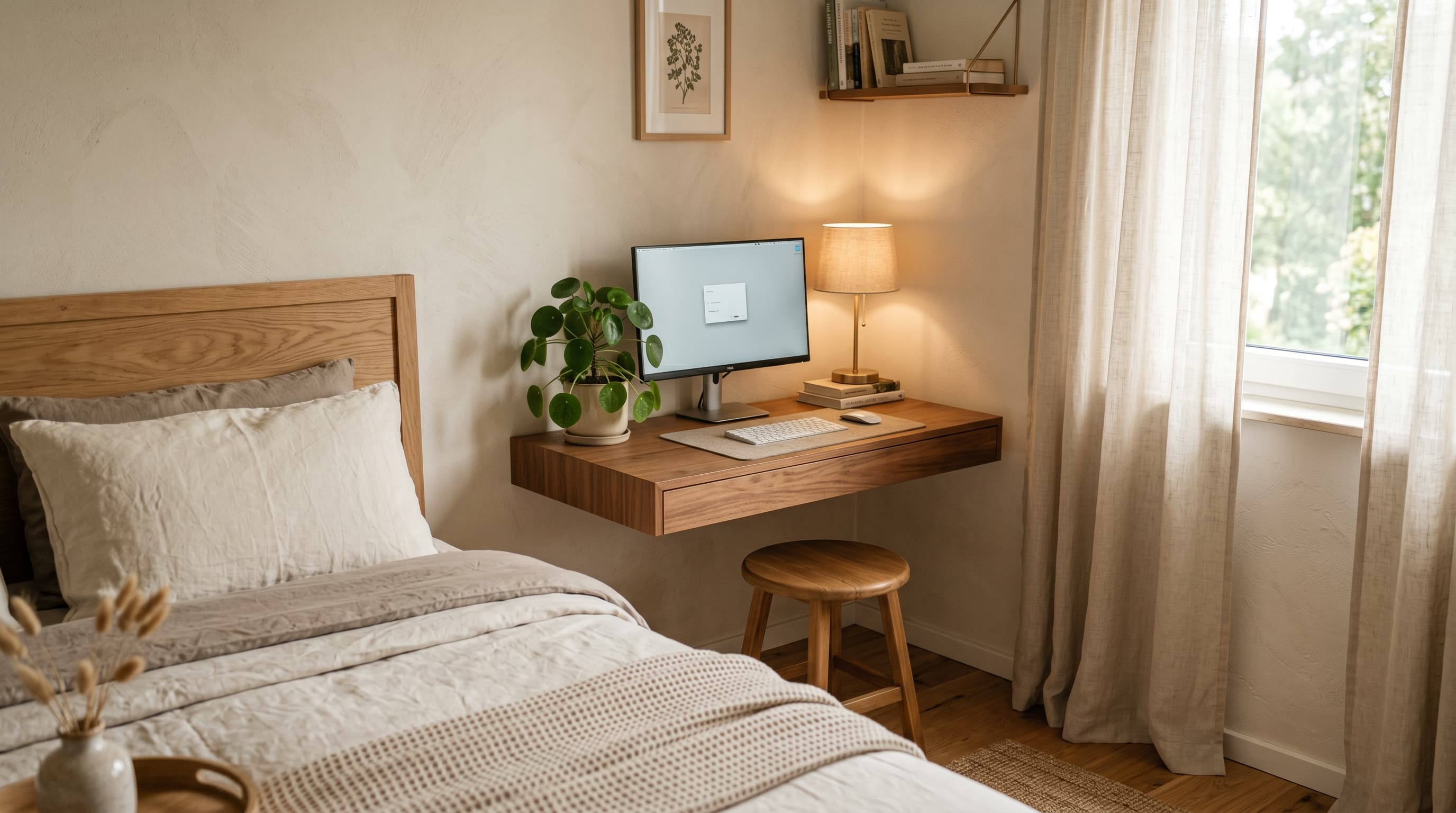
1. Floating wall desk (smallest footprint)
A wall-mounted floating desk is the most space-efficient option available. It takes up zero floor space when not in use if you get a fold-down version, and even a fixed floating desk has no legs eating into your floor area. Most wall desks run 24–40 inches wide and 12–16 inches deep, enough for a laptop or a compact monitor setup. Pair one with a wall shelf above for storage. Space needed: as little as 2 ft × 2 ft of floor clearance for your chair.
2. Corner desk setup
A corner desk uses space that's otherwise dead, the 90-degree meeting of two walls. A compact L-shaped corner desk (48" × 48" or smaller) gives you two working surfaces without pushing far into the room. One surface handles the monitor, the other handles paperwork, a notebook, or a second screen. Space needed: roughly a 5 ft × 5 ft corner zone. The FlexiSpot E7 fits a corner setup if you want a standing option.
3. Murphy bed + desk combo
If you're working with a studio or a very small bedroom, a murphy bed with an integrated fold-down desk is worth the investment. When the bed is up, you have a full workspace. When the bed is down, the desk is hidden. The psychological benefit is real, you physically cannot see your work setup when you're sleeping. Space needed: 8–10 ft of wall clearance for the murphy unit, with 6 ft of floor space in front when the bed is deployed.
I've spent time in an apartment where the previous tenant had a murphy bed + desk combo installed. The transition from "office mode" to "bedroom mode" took 60 seconds and made the space feel genuinely different in each configuration. It's the most complete solution to the stimulus control problem.
4. Behind-the-door desk zone
The wall behind a door is almost always unused. A narrow floating shelf or a slimline desk mounted there creates a surprisingly usable workspace in a spot that doesn't compete with any other furniture arrangement. This works best in bedrooms with doors that open inward and have at least 18 inches of clearance behind them. Space needed: 18–24 inches of wall width, 12–14 inches of depth.
3 More Bedroom Office Setups Worth Considering
These three options lean toward more permanent or more creative solutions. They work especially well for very small rooms, or when you want the work zone to disappear entirely at the end of the day.
5. Closet office (cloffice)
A standard reach-in closet is 24 inches deep and 36–60 inches wide, exactly enough for a desk, a monitor, and some shelving. Remove the hanging rod, add a desk shelf at the right height, install a small LED light bar, and run a power strip to the back corner. When work is done, close the doors. Out of sight means out of mind. This is one of the strongest setups for stimulus control because the work zone disappears entirely. Space needed: your existing closet footprint.
6. Room divider partition
A tall room divider or folding screen (5–6 feet high) placed between the desk and the bed creates a visual barrier without any construction. You still have a dedicated work zone, but the desk isn't the last thing you see before closing your eyes. Fabric panels, wood-frame screens, and tall bookcases all work. This pairs well with any desk style, it's a separation strategy, not a desk design itself.
7. Fold-down wall desk
Different from a fixed floating desk, a fold-down wall desk has a hinged surface that folds flat against the wall when not in use, reducing its visible footprint to a wall panel. Some designs include a built-in shelf that remains accessible whether the desk is open or closed. This is a strong option for very small bedrooms where even a fixed floating desk feels intrusive. Space needed: fold-down desks are typically 30–40 inches wide, you need the same clear floor area as a regular desk when open, but zero floor impact when closed.
What Gear Actually Makes Small Spaces Work?
Poor ergonomics in small spaces is a real health risk, not just discomfort. A 2025 study of 1,064 remote workers found that workers with poor workstation setups had 2x the odds of developing neck and upper back pain compared to those with proper ergonomic arrangements (PMC, 2025). In a bedroom where space forces compromises, the right gear is what keeps those compromises from becoming injuries.
Citation capsule: A 2025 study of 1,064 remote workers found that poor workstation setup doubled the odds of neck and upper back pain (PMC, 2025). In compact bedroom offices where desk depth is often limited, a monitor arm is the most effective tool for achieving correct monitor height and distance without requiring a larger desk surface.
Monitor arm. This is the single highest-impact piece of gear for a small bedroom desk. Mounting your monitor on an arm frees up the entire base footprint of your monitor stand, typically 8–12 inches of desk depth, and lets you position the screen at the exact height and distance your neck needs. The Huanuo monitor arm is a solid, affordable option that works with most 17–32 inch monitors. Paired with an LG 27" monitor, it's a clean, space-efficient primary display setup. For more options, the best monitor arms guide covers the full range.
USB hub. A compact USB hub consolidates your peripheral connections to one cable running to your laptop or desktop. Less cable sprawl, fewer things plugged directly into the wall. The Anker USB hub is small enough to mount under the desk with command velcro or sit at the back edge of even a narrow floating desk. Good cable management matters more in a bedroom than in a dedicated office, visual clutter bleeds into your sleep environment.
Desk pad. A desk pad does two things in a bedroom setup: protects the surface, and creates a defined visual boundary for the work zone. When it's out, it's work time. Rolling it up at the end of the day is a small ritual that reinforces the mental separation. The Knodel desk pad is a large, leather-look mat that works on narrow floating desks.
Chair. Don't compromise on the chair just because the space is small. The HINOMI H1 Pro is a full-featured ergonomic option for larger budgets. For tighter spaces and smaller frames, the Autonomous ErgoChair Jr is the better fit. Either way, the best office chairs guide has a dedicated section on compact ergonomic picks.
Under-desk cable tray. The Vevor cable tray mounts under the desk and keeps your power strip and cable slack off the floor. In a bedroom, cables on the floor are a tripping hazard in the dark, this is more than aesthetics.
How Should You Handle Lighting in a Bedroom Office?
Lighting in a bedroom office does double duty, it has to support focused work during the day and not interfere with your wind-down at night. The most common mistake is using the same overhead light for both, which means either too little light for work or too much stimulating blue-spectrum light at night.
You need a dedicated desk lamp. Overhead lighting in a bedroom is typically ambient and often positioned behind you when you're at a desk, which creates glare on your screen and poor task illumination. A desk lamp positioned to the left (if you're right-handed) or right of your monitor at eye level gives you direct, controllable task lighting without washing the whole room.
As a rule, position your desk so the window is to your side, not directly in front of or behind your monitor. Directly in front means fighting screen glare all day. Directly behind means your camera produces a silhouetted image on every video call. Side-facing natural light is the sweet spot.
Use your lighting to signal mode shifts. A warm-toned desk lamp (2700–3000K) during evening work hours versus bright white overhead light during the day creates an environmental cue your brain can actually read. When you switch the desk lamp off at the end of the day, that change reinforces the transition out of work mode. It sounds minor. In practice, after a few weeks, your body starts treating it as a wind-down signal.
Avoid blue-spectrum LED light (5000K+) in the hours before bed, it suppresses melatonin production, and the biology behind this is well established. A smart bulb set to warm white in the evening removes the decision entirely. For a full breakdown of layered home office lighting, task, ambient, and bias lighting, the home office lighting ideas guide covers every scenario including bedroom setups.
Why a Shutdown Ritual Matters More Than You Think
Leaving your work setup "live" in your bedroom, laptop open, notifications on, documents spread out, is the fastest way to undermine both your sleep and your focus the next morning. The Sleep Foundation identifies this as a stimulus control problem: your brain learns to associate the bedroom environment with work-related arousal and stress, and that association is durable (Sleep Foundation, 2024). Once established, a racing mind at bedtime becomes a recurring problem.
WFH Research data from Stanford shows that 25% of all paid workdays in the U.S. are now worked from home as of March 2025 (WFH Research / Stanford, 2025). For bedroom workers, that's a lot of daily exposure to an environment that doubles as a sleep space. The risk compounds over time without deliberate boundary management.
A practical shutdown routine doesn't need to be elaborate. Close the laptop. Put it in a bag or a drawer, somewhere it's not visible from the bed. If you use a desktop, turn the monitor off and push it back. Flip the desk pad. Change the lighting. Those four steps take 90 seconds and create a clear environmental break.
The APA's Work in America 2024 Survey found that 81% of workers in their preferred work location reported good or excellent mental health, compared to 67% in non-preferred locations. Environment shapes wellbeing in ways that compound over time. The shutdown ritual is how you make the bedroom work for you in both modes, not just one.
Frequently Asked Questions
Is it okay to have a home office in your bedroom?
Yes, with the right setup. The key is creating a clear visual and physical separation between your work zone and your sleep zone. Use a room divider, a dedicated desk corner, or a murphy bed desk to keep work and rest mentally distinct. Avoid working from the bed itself.
How do I set up a home office in a small bedroom?
Use a wall-mounted floating desk to save floor space, keep the desk against one wall away from the bed, and use vertical storage (shelves above the desk) instead of floor-standing furniture. A compact monitor arm frees up surface space. Good cable management keeps the area feeling clean.
Does working in the bedroom affect sleep?
It can, if you're not careful. Sleep researchers call this stimulus control, your brain links spaces with specific activities, and if it associates your bedroom with work stress, falling asleep becomes harder. The fix: physically separate the work zone, shut down your computer at a consistent time, and avoid working from the bed.
A bedroom office isn't a compromise, it's a specific design problem with real solutions. Start with the separation principle, pick a desk format that fits your square footage, and build a shutdown routine before the setup is finished. The gear matters, but the habits are what make it work long-term.
For a prioritized gear list that works in any room, the home office setup under $500 guide covers what to buy first. For desk-specific picks with a small footprint, the small home office ideas guide has more options worth considering. If noise isolation is a challenge in your bedroom office, our guide on how to soundproof a home office covers renter-friendly options, door seals, acoustic curtains, and sound masking, that don't require drilling. If you're working from a studio or open-plan apartment rather than a dedicated bedroom, the small space home office guide covers the layout challenges specific to shared living areas.