Most remote workers won't spend $1,400 on a chair. That's a reasonable position. But it gets used to justify an $80 task chair that starts causing back pain by week three — which isn't a reasonable outcome when real alternatives exist.
The average office worker sits 10+ hours per day, according to research cited by the Mayo Clinic — and the American Chiropractic Association reports that back pain is one of the most common reasons for missed work and doctor visits (acatoday.org). Your chair is doing most of the physical work in your day. At under $200, you won't get Herman Miller engineering. But you can get adjustable lumbar support, a breathable mesh back, and a stable swivel base that actually protects your spine.
This guide covers the six best office chairs under $200 in 2026, ranked by use case. We'll also tell you honestly when spending more makes sense. If you're building out a full workspace on a budget, our home office setup under $500 covers everything else in priority order.
TL;DR: The Branch Task Chair (~$149–$199) is the best office chair under $200 for most people, it's the only sub-$200 chair with build quality close to chairs costing twice as much. The American Chiropractic Association identifies back pain as a leading cause of missed work (acatoday.org). The six picks below address that risk without requiring a four-figure budget.
Can You Actually Get a Good Office Chair for Under $200?
The honest answer is yes, with specific trade-offs you should understand before buying. The American Chiropractic Association notes that back pain is one of the leading causes of missed work in the U.S. (acatoday.org). A sub-$200 chair won't eliminate all seated discomfort, but the right one will dramatically outperform a basic task chair.
Here's what you get at this price point: adjustable lumbar support (height-adjustable in most cases), a breathable mesh back, swivel base with gas-lift height adjustment, and basic armrests. These are the core ergonomic features that move the needle for most people.
Here's what you sacrifice compared to a $400–$1,500 premium chair:
- Seat foam durability. Budget seat cushions compress within 2–3 years of daily use. Premium chairs like the Herman Miller Aeron use molded polymer mesh that doesn't compress at all.
- Adjustment range. True 4D armrests (height, width, depth, and angle) are rare under $200. Seat depth sliders are nearly absent. You get the big adjustments, not the fine-tuning.
- Build quality and finish. Plastic components, armrest padding, and overall assembly tolerance are all noticeably different from a $600+ chair. It's not a deal-breaker, but you'll feel it if you've sat in an Aeron.
- Warranties. Most sub-$200 chairs carry 1–2 year warranties. Premium chairs run 5–12 years. A shorter warranty signals realistic lifespan expectations from the manufacturer.
None of those trade-offs make these chairs bad. They make them appropriate for specific use cases, and the right pick for your body and hours matters more than the price tier alone. For workers focused on work from home productivity across a full day, the right budget chair beats the wrong expensive one.
Citation capsule: The Mayo Clinic cites research showing the average office worker sits 10+ hours per day, and the American Chiropractic Association identifies back pain as one of the most common causes of missed work and doctor visits in the U.S. (acatoday.org). At 10 hours of daily sitting, the quality of your chair's lumbar support isn't a comfort preference, it's a physical health decision.
What to Look for in a Budget Office Chair
Under $200, you can't have everything. So the question is which features matter most for your body and your hours. At 6–8 hours of daily sitting, the specs below carry real physical consequences, not just spec-sheet relevance.
Lumbar Support
This is the feature that matters most. A fixed lumbar pad does nothing for users whose back height doesn't match the pad's position. Height-adjustable lumbar is the minimum worth buying. Some sub-$200 chairs also offer depth adjustment, which controls how firmly the pad presses against your spine, that's meaningfully better.
Fixed lumbar pads are common in the cheapest chairs in this category. Don't buy one for a primary desk if you sit more than four hours daily.
Seat Depth
Seat depth determines whether the front edge of the seat cuts into the backs of your thighs. Longer legs need more depth; shorter legs need less. A non-adjustable seat that doesn't match your leg length causes circulation restriction and discomfort within an hour.
Full seat depth sliders are nearly impossible to find under $200. What to look for instead: a seat pan that's at least 17–19 inches deep, which accommodates most leg lengths without an adjustment mechanism.
Armrests
At minimum, height-adjustable arms. They let you align your elbows at 90 degrees for your specific desk height, reducing shoulder tension. Width-adjustable arms are a meaningful upgrade, they let you bring the armrests under your shoulders rather than holding your arms out awkwardly.
True 4D armrests (height, width, depth, and angle) are rare under $200 but do appear in a few models. When you find them at this price, it's a genuine differentiator.
Breathable Mesh Back
Foam backs trap heat and compress over time. A proper mesh back breathes during long sessions and conforms to your spine's shape dynamically rather than holding a fixed position. All six chairs in this guide use mesh backs. If a chair under $200 uses foam, skip it.
Weight Capacity
Most sub-$200 chairs are rated for 225–275 lbs. If you're near or above that ceiling, the Flexispot BS14 and Nouhaus Ergo3D are worth prioritizing. Never buy a chair rated for less than your weight, the structural failure isn't sudden, but gradual degradation means you lose support before you lose the chair.
Warranty Length
A 1-year warranty signals a manufacturer's honest assessment of their product's lifespan under daily use. Two years is better. The Branch Task Chair and HON Ignition 2.0, both with 2-year warranties, are worth the premium over 1-year alternatives because you're not replacing them after 14 months.
The 6 Best Office Chairs Under $200 in 2026
The right pick at this price point genuinely changes how your body feels at 5pm. Here's how the six chairs stack up before the full reviews:
| Chair | Price Range | Best For | Warranty |
|---|---|---|---|
| Branch Task Chair | $149–$199 | Best overall build quality | 2 years |
| HON Ignition 2.0 | $150–$190 | Best for long hours / durability | 2 years |
| Sihoo M57 | $100–$130 | Best value under $150 | 1 year |
| Flexispot BS14 | $90–$120 | Best lumbar support under $150 | 1 year |
| Nouhaus Ergo3D | $170–$190 | Best for tall users | 2 years |
| Sidiz T50 | $150–$180 | Best slim build for small spaces | 2 years |
1. Branch Task Chair — Best Overall Under $200
Best for
Home office workers who want the closest thing to a premium chair without crossing $200. The Branch Task Chair's build quality, particularly its adjustable lumbar, 3D armrests, and assembly tolerance, is noticeably above everything else in this price range.
We've sat in a lot of chairs at this price. The Branch Task Chair is the one that doesn't feel like a compromise. The lumbar support is height-adjustable with a meaningful range, not a fixed bump positioned for an average body that may not be yours. The 3D armrests (height, pivot, and width) are unusually capable for a sub-$200 chair, and the mesh back has genuine breathability rather than perforated plastic pretending to be mesh.
The seat cushion is firmer than some users expect. Branch uses a higher-density foam than budget chairs typically use, which means it doesn't feel plush on day one, but it also hasn't compressed into nothing by month eight. That's the right trade-off for a long-term work chair.
At $149–$199, the 2-year warranty puts it at roughly $75–$100 per year of expected use. That's competitive with chairs in the $250 range when you account for warranty length. It's the only sub-$200 chair we'd feel comfortable recommending to a full-time remote worker as a primary seat.
The one honest limitation: no seat depth adjustment. If your legs are significantly longer or shorter than average, you'll feel the fixed seat pan more than other users will.
Pros
- Build quality clearly above the sub-$200 average, feels close to $300 chairs
- Height-adjustable lumbar with real range, not a cosmetic bump
- 3D armrests (height, width, pivot), rare at this price point
- Genuine mesh back with actual breathability over long sessions
- 2-year warranty, best-in-class for this price range
Cons
- No seat depth adjustment, fixed pan may not suit very long or very short legs
- Firmer seat cushion than expected, takes a few days to appreciate the durability trade-off
- Limited color options compared to more established brands
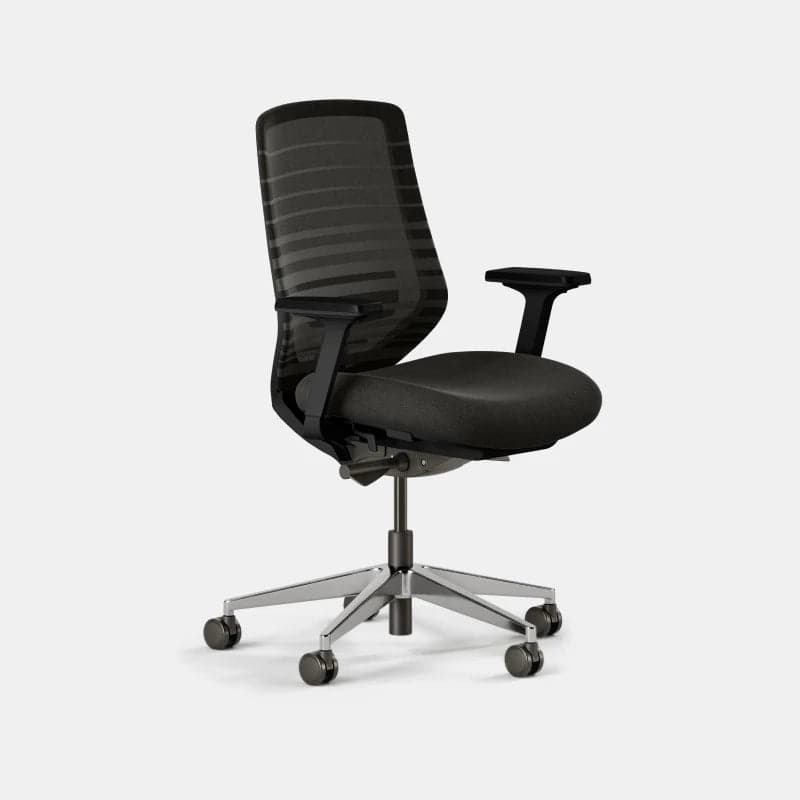
Branch
Branch Task Chair
The only sub-$200 chair with build quality close to $300 alternatives. 3D armrests, adjustable lumbar, 2-year warranty.
2. HON Ignition 2.0 — Best for Long Sitting Hours
Best for
Remote workers who sit 6–8 hours daily and want office-grade durability at a consumer price. HON makes chairs for corporate environments, the Ignition 2.0 is built to the same durability standards as furniture that survives in shared office spaces.
HON is a commercial office furniture brand. The Ignition 2.0 was designed for shared office environments where chairs get used by multiple people at different heights and weights across a full workday. That heritage shows in the construction. The adjustment mechanisms feel more solid than anything else at this price, and the chair's capacity for 300 lbs is among the highest in the sub-$200 category.
The lumbar support is height-adjustable, which covers the most important ergonomic base. Armrests are height-adjustable only (2D), not as capable as the Branch Task Chair's 3D arms, but they stay in place and don't wobble, which is a more common failure mode than you'd expect in budget chairs. The breathable mesh back is a genuine performance feature, not a cosmetic one.
In our experience, the HON Ignition 2.0 is the right call when longevity is the priority. Where a standard sub-$200 consumer chair starts to show wear at the adjustment knobs and armrest pivots around month 12–18, the HON's commercial-grade build holds noticeably longer. You're paying for a chair that was engineered to survive office environments, not a home office showroom.
The trade-off is aesthetics. It looks like a corporate chair, which it is. If that's fine for your workspace, it's an excellent choice. If you want something that fits a more styled home office environment, the Branch Task Chair is the better-looking option.
Pros
- Commercial-grade durability built to survive shared office environments
- 300 lb weight capacity, among the highest under $200
- Genuine breathable mesh back handles full-day sessions without heat buildup
- Height-adjustable lumbar keeps the most important ergonomic feature functional
- 2-year warranty with a brand that actually stands behind it
Cons
- 2D armrests only (height-adjustable), no width or pivot adjustment
- Corporate aesthetic doesn't suit styled home office setups
- No seat depth adjustment
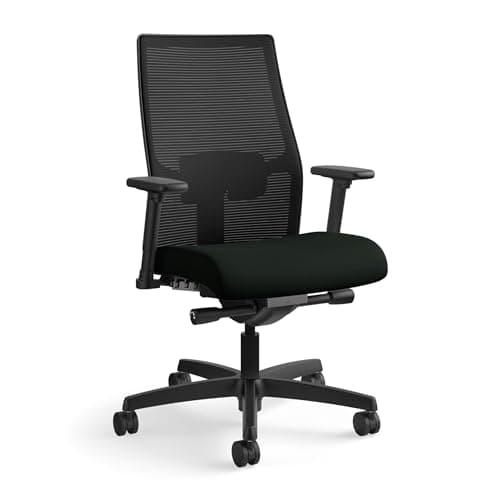
HON
Ignition 2.0 Office Chair
Commercial-grade durability built for shared office environments. 300 lb capacity, genuine mesh back, 2-year warranty.
3. Sihoo M57 — Best Value Under $150
Best for
Budget-conscious buyers who need a real ergonomic chair under $130. The M57 delivers an adjustable lumbar system and breathable mesh back at a price where most alternatives are basic task chairs with no meaningful ergonomic features.
At $100–$130, the Sihoo M57 is the best-built chair we've found under $150. It's not the M57's absolute feature count that earns it this ranking, it's the quality of the features it does have. The lumbar support is genuinely adjustable (height and angle), not just a fixed pad. The mesh back breathes properly. The swivel base is stable and smooth.
What you sacrifice for the lower price is armrest capability. The M57's 2D armrests (height only) are basic, and the armrest padding is thin. For users who don't rely heavily on armrests, those who position their arms on the desk surface for most typing, this isn't a significant issue. For users who want armrest support as part of their posture setup, step up to the Branch or HON.
The 1-year warranty reflects the honest durability expectations at this price. We'd recommend it for workers sitting 4–6 hours daily, or as a secondary chair. For 8-hour primary use, the warranty gap relative to the Branch Task Chair is worth the extra $50.
Pros
- Best-built chair under $130, materials above the price expectation
- Adjustable lumbar with height and angle control, not just a fixed bump
- Breathable mesh back performs well for 4–6 hour sessions
- Compact footprint suits smaller home office spaces
Cons
- 2D armrests (height only) with thin padding, not suitable for armrest-reliant workers
- 1-year warranty, realistic lifespan under full-time daily use is 2–3 years
- 225 lb weight capacity, not a big-and-tall option
4. Flexispot BS14 — Best Lumbar Support Under $150
Best for
Workers whose primary complaint is lower back discomfort and who want the best lumbar system they can get under $150. The BS14's S-curve lumbar is more precisely shaped than the flat pads most budget chairs use.
Most budget chair lumbar systems are flat pads. The Flexispot BS14 uses an S-curve lumbar design that more closely matches the natural double-curve of the human spine, the inward curve at the lower back and the slight outward curve at the mid-back. For users with existing lower back discomfort, that shape difference is immediately noticeable.
The armrests are height-adjustable but otherwise basic. The mesh back breathes adequately for the price. At $90–$120, it's the most affordable chair on this list with a lumbar system worth calling ergonomic. The 1-year warranty and 250 lb capacity place it in the same durability tier as the Sihoo M57.
It's not the right chair if armrests or seat adjustability are priorities. But if lower back support is the specific problem you're trying to solve on a tight budget, the BS14's lumbar design solves it better than alternatives at the same price.
Pros
- S-curve lumbar support more closely matches natural spine shape than flat-pad alternatives
- Lowest price on this list at $90–$120
- Adequate mesh breathability for 4–6 hour sessions
- 250 lb capacity, slightly higher than the Sihoo M57
Cons
- Basic 2D armrests, height adjustment only
- 1-year warranty signals realistic short-term durability
- No seat depth adjustment
- Build quality reflects the lower price, adjustment knobs feel less solid
5. Nouhaus Ergo3D — Best for Tall Users
Best for
Users between 5'10" and 6'3" who've found that standard budget chairs don't fit their frame. The Ergo3D's seat height range, back height, and headrest positioning accommodate taller bodies better than most chairs in this price range.
Standard office chairs are engineered for a median body: approximately 5'6"–5'10", 140–180 lbs. If you're above that range, you've probably experienced the gap, the lumbar pad hits the wrong spot, the headrest doesn't reach, the seat pan feels too short. The Nouhaus Ergo3D addresses those problems with an extended seat height range, a taller mesh back, and an adjustable headrest that actually reaches for users above 6 feet.
The lumbar support is height-adjustable, and the 2-year warranty is among the better guarantees at this price. Armrests are 3D (height, pivot, and fore-aft), genuinely capable for a $170–$190 chair. At 275 lbs capacity, it's not designed for significantly larger frames, but it handles the tall-and-lean body type well.
What you give up compared to the Branch Task Chair is the overall build quality refinement. The adjustment mechanisms work correctly but feel less premium. For tall users, though, a chair that fits your body in the places that matter beats a slightly better-built chair that doesn't.
Pros
- Extended seat height range and taller back specifically suit users above 5'10"
- Adjustable headrest actually reaches for users at 6'+ height
- 3D armrests (height, pivot, fore-aft), good for arm positioning at a range of desk heights
- 2-year warranty at $170–$190, solid value for the category
Cons
- Build quality below the Branch Task Chair, adjustment mechanisms feel less refined
- 275 lb weight capacity, not suitable for larger frames
- Proportions don't suit users under 5'8" as well as standard-fit chairs
6. Sidiz T50 — Best Slim Build for Small Spaces
Best for
Home office workers in tight spaces, apartment desk corners, bedroom setups, small studies, who need a capable ergonomic chair that doesn't visually or physically overwhelm the room. The T50's narrow profile and lighter weight make it the most space-efficient pick here.
Most chairs in this guide are standard-width ergonomic builds, fine for a dedicated home office, but physically large for a studio apartment corner desk. The Sidiz T50 has a noticeably slimmer silhouette without eliminating the ergonomic features that matter. The lumbar support is adjustable, the mesh back breathes properly, and the 2-year warranty gives it better long-term durability signals than 1-year alternatives.
The armrests are height-adjustable. The seat is narrower than standard, which is exactly what makes it work in tight spaces, but also means it suits a slimmer build better than a wider one. At $150–$180, it sits in the middle of the sub-$200 range with a feature set that competes well for its intended use case.
If you're pairing a desk chair with a space-constrained setup and want something other than a basic task stool, the T50 is the right call. For context on building a full functional workspace in a limited footprint, our standing desk converter guide covers desk solutions that pair well with slim chairs like this one.
Pros
- Slim profile, the most space-efficient ergonomic chair on this list
- Lighter weight makes repositioning easy in small or multipurpose rooms
- Adjustable lumbar support, the critical feature is present
- 2-year warranty, better durability confidence than 1-year alternatives
- Clean aesthetic suits styled apartment and bedroom office setups
Cons
- Narrower seat suits slimmer builds, not ideal for wider frames
- 2D armrests (height only), no width or pivot adjustment
- Lighter build means less structural solidity than the Branch or HON
Choosing Between These Six Chairs
Citation capsule: The American Chiropractic Association identifies back pain as one of the most common reasons for missed work and doctor visits in the U.S. (acatoday.org). Given that the Mayo Clinic cites research showing average office workers sit 10+ hours daily, chair ergonomics at any price point, including under $200, directly affects the physical outcomes associated with that sedentary load.
Here's the prioritized summary for buyers choosing between the six chairs above:
If lumbar support is your primary concern: Flexispot BS14 (under $120) or Branch Task Chair (best overall lumbar quality).
If long hours are the issue: HON Ignition 2.0. It's the only sub-$200 chair with commercial-grade construction built for 8-hour daily use across multiple users.
If you're tall (5'10" and above): Nouhaus Ergo3D. The extended height range solves the fit problem that makes other chairs frustrating for taller frames.
If space is the constraint: Sidiz T50. Nothing else in this guide has a comparable slim footprint with actual ergonomic features.
If budget is tight but quality still matters: Sihoo M57 at $100–$130 outperforms everything else under $150.
If you want the best available under $200: Branch Task Chair. Build quality that competes with chairs at twice the price, a 2-year warranty, and 3D armrests that most chairs in this range don't offer.
Budget Chair vs. Premium Chair: When Should You Upgrade?
At 8+ daily hours with recurring back pain, the ROI math on a better chair changes completely. A sub-$200 chair is appropriate for workers sitting 4–6 hours daily who aren't experiencing significant discomfort, it's not the right long-term answer for a full-time remote worker whose day runs 8–10 hours.
The break-even calculation is straightforward. A $350 ergonomic chair with a 3-year warranty costs roughly $117/year. The Branch Task Chair at $180 with a 2-year warranty costs $90/year. The annual cost difference is about $27. But the $350 chair offers structural lumbar systems, seat depth adjustment, and construction that holds up through 3 years of daily use, the sub-$200 chair may need replacement in that window.
If you're sitting 8 hours daily and your current chair is causing pain, that's the signal to step up. Our guide to ergonomic chairs under $300 covers the options in the next tier, chairs with adjustable lumbar depth, seat depth sliders, and better long-term foam durability than anything in this guide.
What a better chair won't fix on its own is prolonged static sitting. Pairing any chair in this guide with movement breaks and a standing desk converter addresses the sedentary load problem more completely than any seat upgrade alone.
The six chairs above cover the real range of sub-$200 needs: the best overall build, the most durable commercial option, the best value under $150, the strongest lumbar system for the price, the best fit for tall users, and the only ergonomic chair genuinely designed for small spaces.
None of them are Herman Millers. They're not meant to be. But they're all meaningfully better than the $80 task chair that causes back pain by month two, and at 10 hours of daily sitting, that gap matters more than the price difference suggests.