There's a practical case for plants in your home office that has nothing to do with aesthetics. A 2014 University of Exeter study found employees in workplaces with plants reported 15% higher productivity and significantly greater concentration compared to those working in sparse, undecorated spaces (University of Exeter / Journal of Experimental Psychology: Applied, 2014, Dr. Chris Knight). That's a meaningful return on a $15 purchase.
The less-appreciated angle: plants are one of the cheapest, most effective ways to improve how your workspace looks on a video call. A tall snake plant in the corner of your frame reads as intentional. A trailing pothos on a shelf above the camera adds warmth without clutter. The right plant in the right spot makes your background look designed, not assembled by accident.
This guide covers seven low-maintenance plants worth having in a home office — including which ones work in windowless rooms, which are safe for pets, and exactly where to put them for maximum visual impact on camera.
TL;DR: The best all-around home office plant is the snake plant — it tolerates near-windowless conditions, requires watering every 2–6 weeks, and creates immediate visual structure in a video call background. A 2014 University of Exeter study found office plants boost productivity by 15% (kar.ac.uk/46685, 2014). The seven plants below cover every light condition, desk size, and pet situation.
Do Office Plants Actually Help You Focus?
Yes, but probably not for the reason most articles give. A 2014 University of Exeter study (Dr. Chris Knight) found that enriched offices with plants produced 15% higher self-reported productivity and raised concentration levels compared to lean, undecorated workspaces (kar.ac.uk/46685, 2014). The researchers attribute the effect to reduced stress and improved psychological wellbeing, not measurable changes to air quality.
The air quality story is more complicated. NASA's 1989 Clean Air Study identified plants that filter VOCs including benzene, formaldehyde, and trichloroethylene from enclosed spaces (NASA Technical Report, B.C. Wolverton, 1989). That finding gets cited constantly. What rarely gets mentioned is the 2019 follow-up in the Journal of Exposure Science and Environmental Epidemiology, which calculated you'd need more than 1,000 plants per 10 square feet to match the air-filtering capacity of a standard HVAC system. At realistic desk-plant counts, air quality improvements are modest at best.
Citation capsule: A 2014 University of Exeter study (Dr. Chris Knight, published in Journal of Experimental Psychology: Applied) found that office workers in enriched workplaces with plants reported 15% higher productivity and greater concentration than those in minimal, undecorated offices. The effect was attributed to reduced stress and improved wellbeing rather than measurable air quality changes (kar.ac.uk/46685, 2014).
What does hold up: the American Psychological Association notes that natural elements in a workspace, including plants and views of nature, reduce cortisol and self-reported stress. That stress reduction is likely the real mechanism behind the productivity bump, not direct air filtration. So plants work, just not through the pathway the internet insists on.
The 7 Best Plants for a Home Office
| Plant | Light Needs | Watering | Pet Safe? | Best Spot |
|---|---|---|---|---|
| Snake Plant | Low–bright indirect | Every 2–6 weeks | ⚠️ No | Floor corner behind monitor |
| Pothos | Low–medium indirect | Weekly | ⚠️ No | Trailing from shelf above desk |
| ZZ Plant | Very low–indirect | Every 2–4 weeks | ⚠️ No | Desktop or low shelf |
| Peace Lily | Low–indirect | When drooping | ⚠️ No | Desk surface or shelf beside monitor |
| Spider Plant | Indirect–medium | Weekly | ✅ Yes | Hanging pot or high shelf |
| Haworthia | Bright indirect | Every 2–3 weeks | ✅ Yes | Desk surface near window |
| Philodendron | Low–medium indirect | Weekly | ⚠️ No | Trailing from shelf above camera |
These seven species were chosen for one core reason: they survive real home office conditions. That means inconsistent watering, imperfect light, and a setup where the plant can't be the highest-maintenance thing on your desk. Care details and placement tips are based on what works in practice, not just what's possible under ideal greenhouse conditions.
1. Snake Plant (Sansevieria / Dracaena trifasciata)
The snake plant is the one to start with if you want a statement piece that's nearly impossible to kill. It tolerates low to bright indirect light, including rooms with no window nearby, and only needs watering every 2–6 weeks. Tall varieties (24–36 inches) are particularly useful for home offices: placed in the back corner of your frame, they create visual depth without taking up desk space.
In practice, the snake plant is the best video call background plant available. Upright, structured, and architectural, it signals intentional design, not a plant plopped somewhere because you forgot to move it.
Pros
- Thrives in almost any light condition, including near-windowless rooms
- Nearly impossible to overwater if you wait for soil to fully dry, water every 2–6 weeks
- Removes airborne toxins per NASA's 1989 Clean Air Study
- Tall varieties create strong visual interest behind a desk without consuming desk surface
Cons
- Mildly toxic to cats and dogs, keep out of reach of pets
- Slow-growing, so it won't quickly fill a space that needs volume
- Dislikes cold drafts from windows or AC vents, avoid placing directly in the airstream
Placement tip: Corner of the room, behind or beside your monitor. At floor level for tall varieties, or on a low shelf for desktop sizes. At that position, it creates depth in your video call background without ever landing in your way during the workday.
2. Pothos (Epipremnum aureum)
Pothos is the trailing vine you want on a shelf above your desk. It handles low to medium indirect light without complaint, tolerates irregular watering, and grows visibly fast enough to feel rewarding. A pothos placed on a shelf 12–18 inches above your camera and allowed to trail down naturally creates the cozy, creative workspace look that's become shorthand for "person who has their home office together."
It's also one of the most forgiving plants for anyone who travels or works inconsistent hours. Miss a watering by a week, it'll be fine. Miss it by two weeks, also probably fine.
Pros
- Trails beautifully from shelves, ideal for video call background depth
- Extremely forgiving of irregular watering schedules
- Grows quickly, which makes progress visible and satisfying
- Nearly indestructible under typical home office light conditions
Cons
- Toxic to cats and dogs if ingested, position out of pet reach
- Gets leggy in very low light and may need occasional pruning
- Needs a shelf or hanging position to look its best, not a desk surface plant
Placement tip: On a shelf 12–18 inches above the desk, ideally just above and behind the camera line. Let the vines trail down toward the desk naturally. Don't cut them short, the drape is the effect.
3. ZZ Plant (Zamioculcas zamiifolia)
The ZZ plant is the one you want if you travel frequently, forget to water things, or work in a room with little to no natural light. It tolerates fluorescent and LED office lighting alone, stores water in its rhizomes, and genuinely doesn't mind if you water it once a month. Its glossy, dark green leaves look healthy and polished even when you haven't touched the plant in weeks.
This is the plant for people who think they can't keep plants alive. In my setup, a ZZ plant on a low shelf beside the desk has gone three weeks without water twice without so much as a drooping leaf.
Pros
- Most drought-tolerant plant on this list, water once every 2–4 weeks and it's fine
- Thrives under artificial light, including LED and fluorescent office lighting
- Glossy leaves look healthy and polished with minimal care
- Virtually pest-resistant, a genuinely hands-off plant
Cons
- Slow-growing, don't expect it to fill a space quickly
- Toxic to pets if ingested; waxy sap irritates skin, wear gloves when repotting
- Watering precision matters on the other end, don't let it sit in water or the roots rot
Placement tip: Desktop-sized ZZ plants work well on a low shelf beside the monitor. Larger varieties are good floor plants for a corner that doesn't get natural light. Either way, keep them away from vents.
4. Peace Lily (Spathiphyllum)
The peace lily earns its spot because it's one of the few flowering plants that genuinely thrives without direct sunlight. It tolerates low to indirect light, produces white blooms that add visual contrast to a green-heavy setup, and has the most useful watering cue of any plant on this list: its leaves droop visibly when it needs water, then recover within hours of being watered. You can't miss the signal.
The NASA Clean Air Study listed the peace lily as one of the top performers for removing ammonia, benzene, formaldehyde, and trichloroethylene from enclosed spaces (NASA Technical Report, 1989). Apply that finding with the appropriate caveat, real-world conditions and realistic plant counts mean the air quality effect is small, but it's there.
Pros
- One of very few flowering plants that thrives without direct sunlight
- White blooms add color contrast to a video call background without looking cluttered
- NASA-listed for VOC removal, benzene, ammonia, formaldehyde
- Droops visibly when thirsty and recovers fast, the most readable watering cue on this list
Cons
- Toxic to pets, keep out of reach of cats and dogs
- Drooping can alarm new plant owners before they learn it's just thirsty, not dying
- Pollen from blooms may bother allergy-prone users during flowering periods
Placement tip: A peace lily works well on a desk surface or a shelf beside the monitor. The white blooms photograph well, they show up cleanly in video calls without competing visually with your face.
5. Spider Plant (Chlorophytum comosum)
Spider plants are the pet-safe option you'll actually want to own. They're non-toxic to both cats and dogs, adapt to most indirect light conditions, and produce small offshoots, "spiderettes", that can be rooted in water and propagated into new plants. They have a light, airy look that doesn't overwhelm a small desk setup.
The honest tradeoff: spider plants need more consistent moisture than the other low-maintenance options on this list. They don't want to dry out completely between waterings the way a ZZ plant does. If you're prone to forgetting to water, pair one with a reminder on your phone, or stick with the ZZ.
Pros
- Genuinely non-toxic to cats and dogs, one of the few safe options on this list
- Adapts well to most indirect light conditions in a home office
- Produces baby plants (spiderettes) that can be rooted and propagated easily
- Light, airy growth habit, doesn't visually overwhelm a compact desk
Cons
- Less forgiving of drought than the ZZ plant or snake plant, needs consistent moisture
- Can develop brown leaf tips from fluoride in tap water, use filtered or distilled water if this appears
- Growth can look sparse in very low light, which reduces visual impact
Placement tip: A hanging pot or high shelf works best, the trailing spiderettes look more interesting from above. If you have pets that might reach a shelf, this is the plant worth positioning higher than usual.
6. Haworthia (Succulent)
Most succulents are the wrong choice for a home office because they need direct or very bright light. Haworthia is the exception. It tolerates indirect light better than nearly any other succulent, making it the only one realistic for desk use near (not in) a window. It's compact, sculptural, and barely needs water, once every 2–3 weeks in growing season, monthly in winter.
Think of Haworthia as the desk accent plant. It doesn't fill a frame or create background depth. It sits beside your keyboard or on the corner of your desk and looks like someone who takes their workspace seriously picked it out deliberately.
Pros
- Compact enough for any desk surface without taking up working space
- Very low water needs, monthly watering is enough in winter months
- Haworthia tolerates indirect light better than most succulents
- Small, sculptural appearance looks intentional and polished on a desk surface or camera
Cons
- Needs more light than other plants on this list, south or east-facing window or a grow light is ideal
- Slow-growing, so it won't change shape or size meaningfully over a season
- Overwatering causes root rot faster than underwatering, precision matters more here than with other picks
Placement tip: Front corner of the desk surface, or on a windowsill directly beside the desk. Keep it near the best light source in the room. If you don't have a window, this is the one plant that most benefits from an LED desk grow light.
LED Desk Grow Light
7. Heartleaf Philodendron
The heartleaf philodendron is the lush alternative to pothos, similar care requirements, faster growth in good conditions, and larger heart-shaped leaves that create a more tropical, full look in a video call background. It handles low to medium indirect light and needs watering when the top inch of soil is dry, roughly once a week in summer.
In practice, a philodendron on a shelf above a dual monitor setup creates the kind of background that looks deliberately composed without requiring any thought to maintain. Just water it weekly and let it grow.
Pros
- Large heart-shaped leaves create a lush, tropical feel in video call backgrounds
- Forgiving of imperfect care, similar resilience to pothos
- Trails beautifully from a shelf, growing faster than pothos in adequate light
- Works well in low to medium indirect light, no bright sun required
Cons
- Toxic to pets if ingested, position out of reach of cats and dogs
- Best on a shelf or in a hanging position, not suited to desk surface placement
- Needs more frequent watering than the drought-tolerant alternatives on this list
Placement tip: On a shelf 12–18 inches above and behind the camera, similar to pothos. The larger leaves create more visual mass than pothos at the same shelf position, which fills a frame faster. For a bedroom office, a philodendron on a floating shelf above the desk is particularly effective.
What If You Have No Windows?
Many home offices, basement setups, interior rooms, windowless corners of an apartment, get essentially no natural light. Most of the low-light plants above will survive on fluorescent or LED ambient lighting alone, but they'll grow more slowly and look less vibrant over time.
A dedicated grow light solves the problem completely. Full-spectrum LED grow lights mimic the color temperature range plants use for photosynthesis, and they run cool enough to leave on unattended. The setup is simpler than most people expect: put the light on a timer set for 12–14 hours on and 10–12 hours off to mimic a natural day cycle. Position the light 6–12 inches above the foliage for most low-light plants.
A grow light on a 12-hour timer means your plants get consistent light even when you close your home office door for the weekend. You don't have to remember to turn anything on.
An LED desk grow light is compact enough to clip onto a shelf or sit beside a monitor without taking up significant space. For a ZZ plant or snake plant in a windowless room, one small grow light on a timer is the difference between a plant that stays alive and one that actually looks good.
The ZZ plant and snake plant are the strongest performers under artificial light. The Haworthia succulent, by contrast, genuinely needs more intensity, it's the one plant on this list where a grow light isn't optional if you have no window.
Pet-Safe Plant Quick Reference
If you have cats or dogs, plant selection matters more than most guides acknowledge. Several popular home office plants are toxic to pets, some mildly, some significantly.
Safe for cats and dogs:
- Spider plant (Chlorophytum comosum), non-toxic
- Haworthia succulents, non-toxic
- Boston fern, non-toxic (not reviewed above, but worth noting)
- Prayer plant (Maranta leuconeura), non-toxic
Toxic to pets, keep out of reach:
- Snake plant, mildly toxic; causes gastrointestinal upset
- ZZ plant, toxic; can cause vomiting and irritation
- Peace lily, toxic; causes oral irritation, vomiting
- Pothos, moderately toxic; causes oral and gastrointestinal irritation
- Heartleaf philodendron, toxic; causes oral irritation and vomiting
The ASPCA maintains a comprehensive toxic and non-toxic plant database at aspca.org/pet-care/animal-poison-control/toxic-and-non-toxic-plants. Check your specific variety before buying, cultivar names matter, and not every plant sold under a common name has the same toxicity profile.
If you have pets and want the least-risk setup: one spider plant on a high shelf and a Haworthia on the desk. Both are non-toxic, look good on camera, and survive real-world home office conditions.
How to Place Plants for Video Calls
The goal isn't to fill your background with greenery. It's to create a visual impression of a thoughtfully set-up workspace, which requires restraint more than volume. Three zones work for almost every home office layout.
The Three-Zone Framework
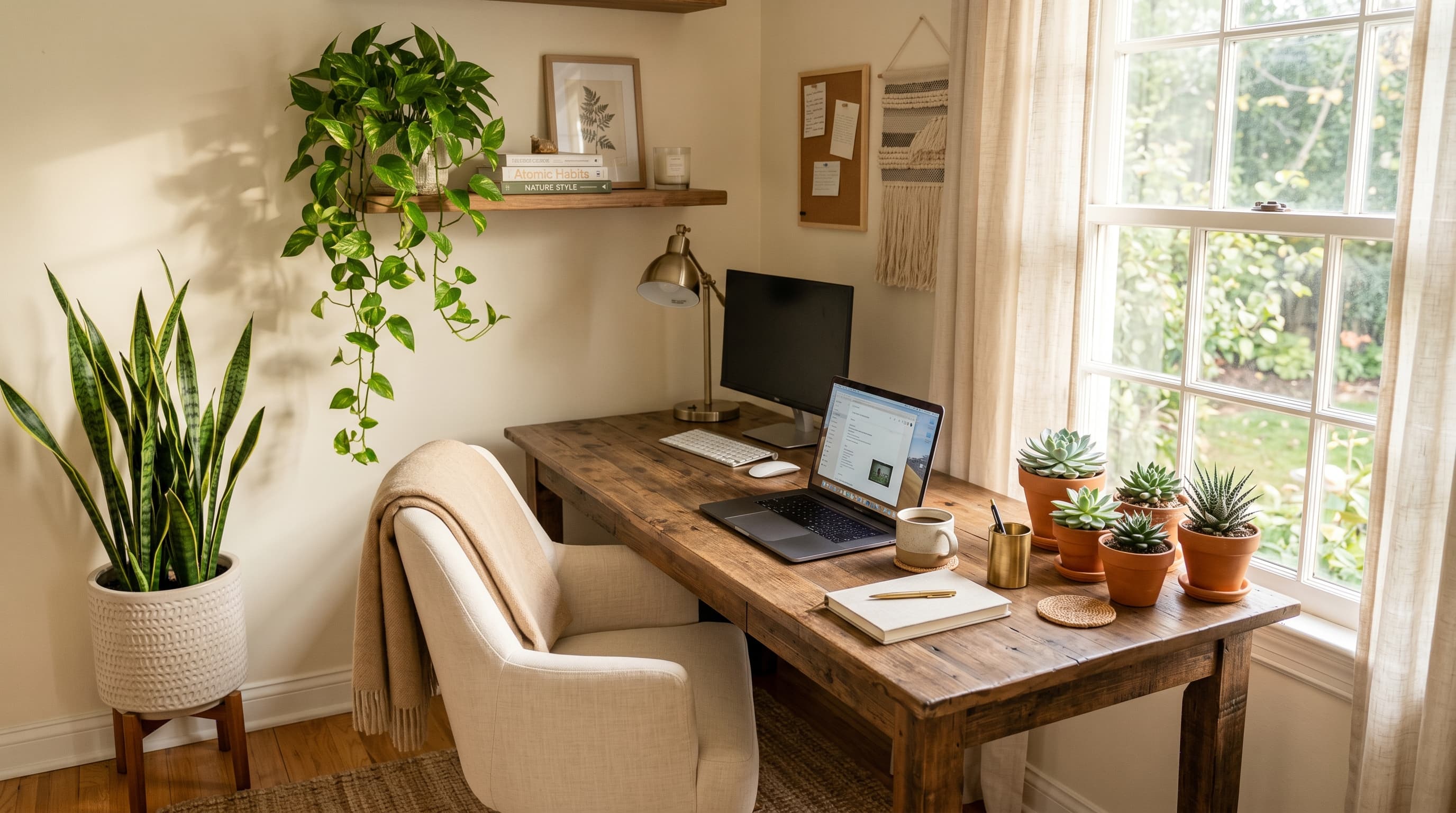
Zone 1, Back corner (tall plants): A snake plant or large ZZ placed in the corner behind and beside your monitor creates depth in the frame. You see the silhouette of the species, not every leaf. It anchors the background without competing with your face.
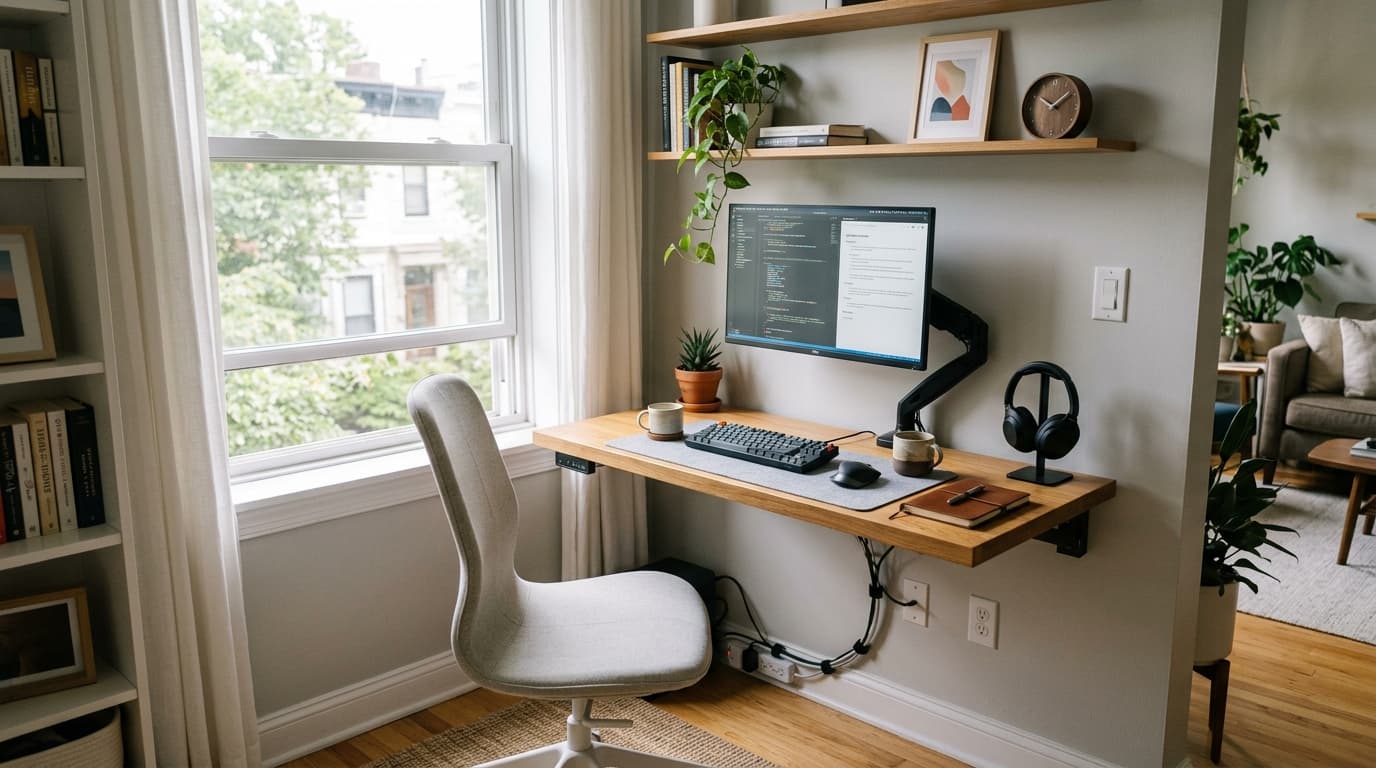
Zone 2, Shelf above desk (trailing plants): Pothos or philodendron on a shelf 12–18 inches above the camera, trailing downward. The vines enter the frame from above and create natural texture. Pair this with task lighting, a warm desk lamp positioned behind the shelf creates a soft glow that makes the trailing foliage visible without blowing out the frame.
Zone 3, Desk surface (small accent): One compact specimen, a Haworthia succulent or small ZZ, on the front corner of the desktop. Visible but unobtrusive. It's the detail that signals the setup was considered, not assembled by accident.
The most effective video call plant setup is a tall statement plant in the back corner of your frame and one small plant beside the monitor. That combination signals intention, not just a random plant sitting on a shelf.
How Many Plants Is Enough?
In practice, three is the right number for most home office setups: one tall corner plant, one trailing shelf specimen, and one small desk accent. More than that and the arrangement reads as a greenhouse rather than a workspace. Fewer than that and the greenery looks like an afterthought rather than a deliberate choice. For a compact home office setup, one trailing shelf plant and one desk accent often covers it without the spatial commitment of a tall floor plant.
A snake plant, a pothos on a shelf, and a Haworthia on the desk surface, that's a complete home office plant setup for under $40. The snake plant handles the background, the pothos handles the warmth, and the Haworthia handles the detail. All three survive irregular watering and imperfect light.
The productivity case is real. The 2014 University of Exeter study found 15% higher productivity in offices with plants (kar.ac.uk/46685, 2014). The video call case is equally real, a plant in the right position makes your background look designed. Both outcomes come from the same $15 plant in the right spot.
If you're still building out the rest of the setup, the home office setup under $500 guide covers lighting, desk, monitor, and chair in priority order, plants are the finish layer, not the foundation.