Most home office advice starts from the wrong place. It assumes you have a spare room.
The average U.S. apartment is approximately 941 square feet (U.S. Census Bureau, 2022). That's not a lot of floor area, and most of it is already spoken for. You're probably working from a corner of your bedroom, a slice of the living room, or a spot at the kitchen table — and the challenge isn't finding motivation to work. It's making a workspace that functions without taking over the only living space you have.
These 11 ideas are built for that reality. They're ordered by impact and grouped by approach. Most cost very little. All of them work in apartments. For a full gear list that fits a tight budget, the home office setup under $500 guide runs parallel to this one.
TL;DR: Most U.S. apartments don't have a spare room, but you don't need one. A monitor arm, a compact desk under 48 inches, and a defined zone (even just a rug) are enough to create a functional, psychologically distinct workspace. Stanford economist Nicholas Bloom's research found that structured home setups produce a 13% productivity gain — structure, not square footage, is what drives that result.
Use Vertical Space First (Ideas 1–3)
Vertical space is the most underused resource in any small home office. Stanford economist Nicholas Bloom's research found that structured home work environments correlate with a 13% productivity gain (Stanford / QJE, 2015). The reason isn't complicated, clear, organized spaces reduce friction, and using your walls for storage and equipment is the fastest way to clear the surface in front of you.
Citation capsule: Stanford economist Nicholas Bloom's peer-reviewed research found a 13% productivity increase for workers in structured, organized home environments (Stanford / QJE, 2015). In small apartments, vertical organization, wall shelves, mounted monitors, floating desks, is the primary mechanism for maintaining that structure without requiring more floor area.
Idea 1: Wall-Mounted Floating Desk
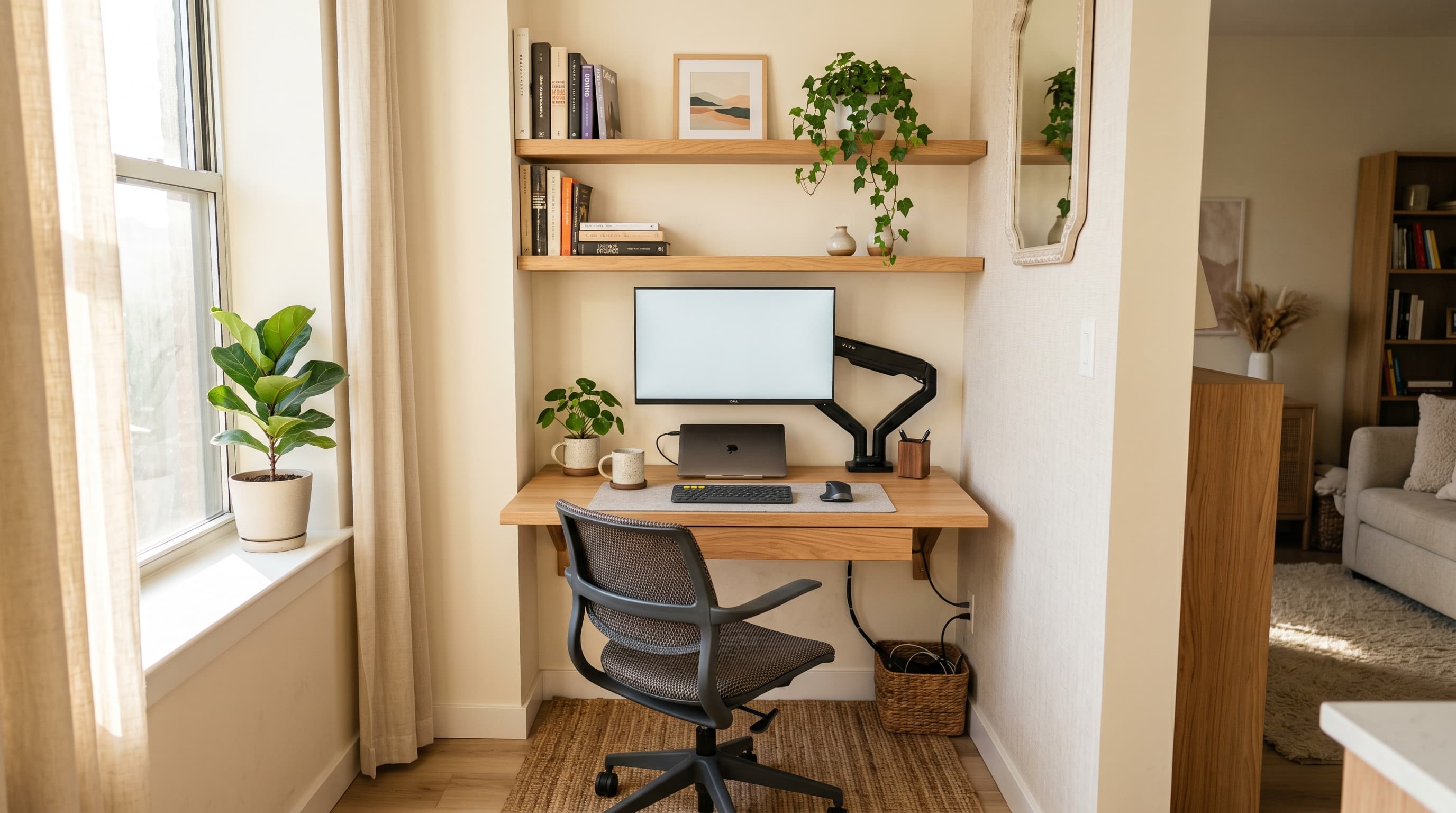
A wall-mounted floating desk has no legs. That means zero floor footprint, which matters enormously when you're working in 80–120 square feet of designated space. Fold-down versions mount flat against the wall when closed, from a distance, they look like a framed panel or a closed cabinet door. Open, they give you a full working surface.
Most floating desks run 24–40 inches wide and 12–16 inches deep. That's enough for a laptop, a monitor, and a small set of speakers if you're tidy about it. Pair the desk with a wall shelf mounted directly above for storage, and you've built a complete workstation without a single piece of furniture touching the floor.
IKEA's NORBERG and KALLAX-compatible wall-shelf setups are popular starting points. Murphy desk kits go a step further, adding concealed storage behind the fold-down surface.
Idea 2: Monitor Arm
This is the highest return-on-investment upgrade for any small desk. A monitor arm replaces the stand that ships with your monitor, the one eating 8–12 inches of desk depth with its base footprint. Mount the arm to the back edge of the desk, clamp or bolt it in place, and the monitor floats at exactly the height and distance your neck needs.
The depth you recover is significant. On a 16-inch-deep floating desk, getting 8 inches back from the monitor stand means your usable workspace just grew by 50%. Push the monitor out of the way during lunch or at the end of the day, and the desk surface is clear. The best monitor arms guide covers specific models across price points.
Idea 3: Wall-Mounted Shelves Above the Desk
The wall above your desk is almost always empty. That's wasted vertical real estate that could hold everything currently stacked on your desk surface, notebooks, headphones, a small plant, reference books, a router.
Standard floating shelves (IKEA LACK or similar) mount in about 20 minutes and can hold 20–30 lbs each. Two shelves at staggered heights give you two distinct storage zones: one at eye level for things you look at frequently, one higher for archive storage. The desk surface underneath can stay completely clear for actual work.
Choose the Right Furniture (Ideas 4–6)
Furniture scale is where most small office setups go wrong. Over 20% of all full U.S. workdays are now done remotely, according to Bloom's ongoing WFH Research data (WFH Research / Stanford, 2025). That's a large and growing population working in apartments that were never designed as offices, and the furniture industry hasn't fully caught up. Most desks are still sized for rooms with walls on all four sides.
Idea 4: Compact Desk Under 48 Inches
A 60-inch desk looks reasonable in a showroom. In a studio apartment, it dominates the room. A 40–48 inch desk is enough for a laptop and a single monitor, and it leaves breathing room on both sides. In our experience testing desk setups across different apartment sizes, a 47-inch desk consistently hits the sweet spot, wide enough for a proper dual-task surface, narrow enough to not overwhelm the room.
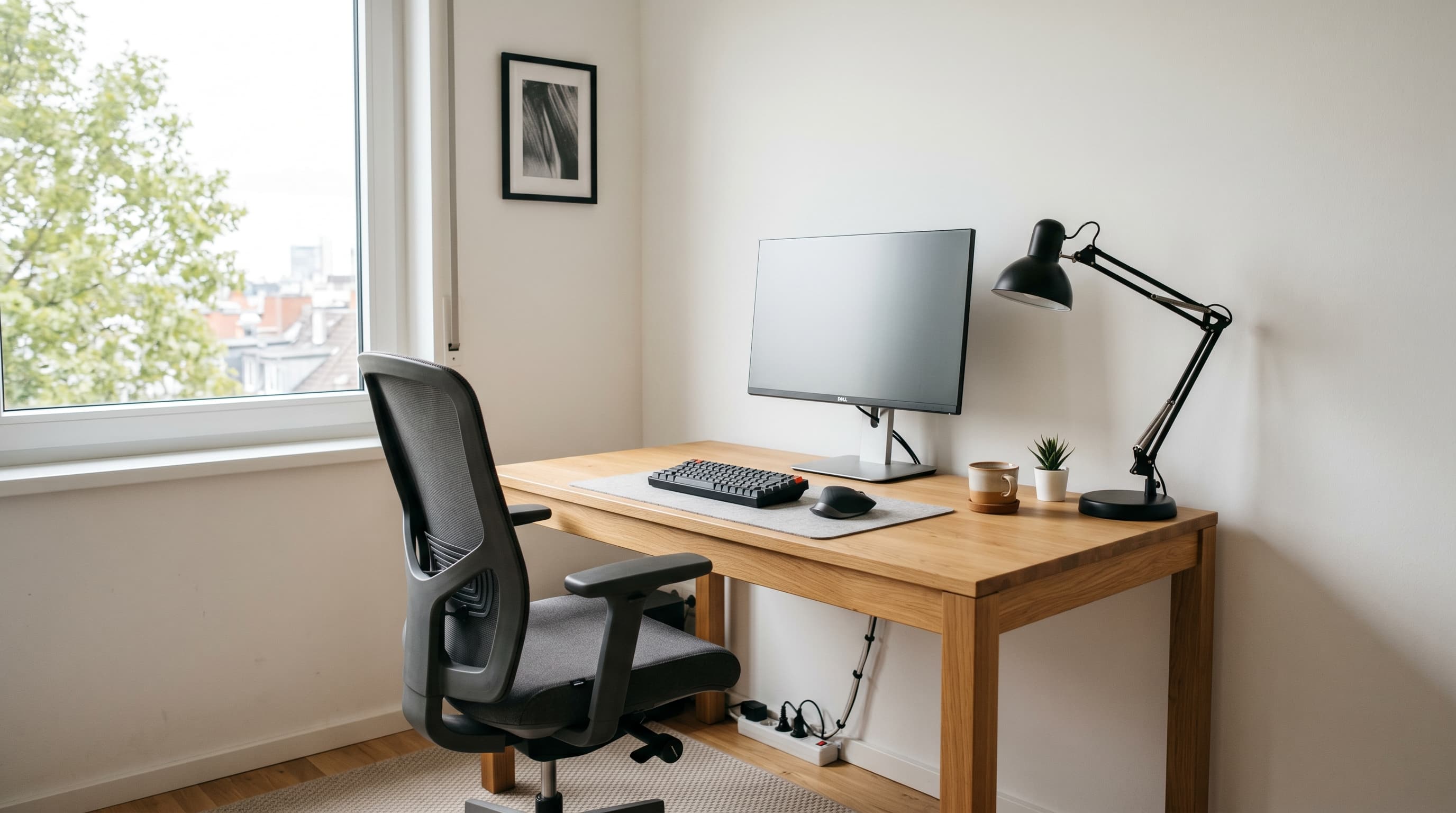
The key spec to watch is depth. Many "compact" desks still run 24–28 inches deep, which eats floor space. Look for desks at 20 inches deep or less if you're working with a tight footprint. Pair with a monitor arm (Idea 2) and you only need 16 inches of depth in practice. The small desk ideas guide has a full breakdown of what fits in different room sizes.
Idea 5: Foldable or Wall-Fold Desk
A foldable desk only exists when you need it. That's the entire value proposition, and it's a real one. If you're in a studio apartment where the workspace shares physical space with a living area or sleeping area, a desk that disappears after 5 PM lets the room feel like a home again in the evenings.
Wall-fold desks mount to studs and hinge down for use. Freestanding fold-flat desks don't require mounting and can be moved to different walls. Either way, the mental effect of a desk that closes is significant, it creates a visual "work is done" signal that a desk left open all evening can't replicate.
Idea 6: A Chair That Tucks Completely Under the Desk
A standard office chair with a wide base and tall back reads as "office furniture" even when you're not sitting in it. That visual weight matters in a small space. A slim task chair or a simple stool that tucks completely under the desk surface disappears when you push it in, from across the room, the workspace looks like a clean shelf, not a workstation.
Slim ergonomic chairs with narrower bases (under 18 inches wide) work well here. Simple task stools are even less obtrusive. The tradeoff is lumbar support, so match the chair to how long you actually sit, a stool works for 2–3 hour sessions, a proper chair matters for 6–8 hour workdays. The budget office chair guide includes compact options that don't sacrifice support.
Create Visual and Physical Separation (Ideas 7–9)
Visual clutter is a productivity tax in any size office. In a small space, it compounds, clutter makes rooms feel smaller, which increases cognitive load, which erodes focus. A defined, contained workspace outperforms an undefined one even when the square footage is identical. These three ideas address that directly.
Idea 7: Bookshelf or Open Shelving as a Room Divider
A tall bookshelf placed perpendicular to the wall, between the desk and the living area, creates a soft boundary without permanent construction. It blocks the line of sight between your work zone and the couch without blocking light, open shelves pass light through, maintaining the sense of space. As a bonus, you get useful storage on both sides.
This approach works well in studios and open-plan apartments where the desk would otherwise sit in plain view of the whole room. A 72-inch bookshelf is roughly eye height standing, enough to create a visual partition. You don't need to fill it with books. A few plants, a lamp, and some neutral storage boxes work just as well and look intentional.
Idea 8: A Dedicated Rug Under the Desk
A rug under the desk is one of the most underrated ideas on this list. It costs $40–$80, takes five minutes to place, and immediately defines the workspace as a distinct zone. The floor treatment signals "this area is different" in a way that no amount of desk organization can replicate.
The psychological effect is real. We've found that having a physical boundary on the floor, even something as simple as a 5×7 rug, reinforces the mental transition between work mode and home mode. When you step off the rug, you've left the office. When you step back on, you're at work. Small rituals built on physical anchors are more durable than willpower alone. For more on the psychology side of this, the work from home productivity guide covers the evidence in more depth.
Choose a low-pile rug that sits flat under a chair with wheels. High-pile rugs catch chair casters and become a frustration quickly.
Idea 9: Cable Management
Visual clutter makes small spaces feel smaller. Cables are the fastest way to make a tidy desk look chaotic, and in a small apartment where the workspace is always in view, that chaos leaks into the whole room. A cable box, a few velcro ties, and a cable tray under the desk is a 20-minute project that changes how the space feels.
The basics: a velcro cable strap ($8 for 20) bundles desk cables into a single run. A cable box ($15–$25) hides the power strip and adapter bricks. A cable tray or raceway mounted under the desk keeps the floor clear. Together, these eliminate the visual noise that makes small offices look cramped even when they're well-organized. The cable management guide covers the specific products worth buying for each approach.
Optimize for the Way You Actually Work (Ideas 10–11)
The last two ideas aren't about furniture or storage. They're about how you use what you have. According to Bloom's ongoing research, more than 20% of all paid U.S. workdays are now done remotely (WFH Research / Stanford, 2025). For most of that workforce, remote work wasn't a deliberate lifestyle choice, it was a structural shift in how work gets done. Optimizing the setup means adapting to that reality, not designing around an imaginary dedicated office room.
Idea 10: Dual-Purpose Furniture
A desk that also serves as a dining table, or a dining table with a dedicated "work corner," solves the multi-use problem that studios face constantly. The key is defining the work zone clearly even on shared furniture. A desk pad at one corner of the dining table marks that corner as the office. A laptop bag stored in one specific spot means setup and teardown take 90 seconds.
This approach requires more discipline than a dedicated desk because the trigger for "work mode" is behavioral rather than physical. That said, it works well for people who work shorter blocks, 3–4 hours of focused work, rather than 8-hour days. For longer days, a dedicated compact desk is worth the floor space.
In practice, the dual-purpose setup works best when gear lives in a dedicated container, a shallow tray, a small basket, or a laptop sleeve with a pocket for cables and accessories. The transition ritual of taking things out and putting them away is what creates psychological separation in the absence of physical separation. Without that ritual, the dining table never feels like an office, and the office never feels fully shut off.
Idea 11: The "Commute Out" Ritual
When space won't allow physical separation between work and not-work, behavior has to fill the gap. Here's a non-physical idea that actually works: leave your apartment for five minutes at the start of the workday and again at the end.
Walk to the end of the block and back. Get a coffee. Check the mail. The destination doesn't matter. What matters is the re-entry. When you walk back in through the door, you're "arriving at the office." When you leave and come back in the evening, you're "coming home from work." The commute, even a fake, five-minute version, creates the transition that your apartment's layout can't.
We've found this one harder to start than it sounds, but stickier than expected once established. After a few weeks, the outbound walk becomes a natural trigger for shifting into work mode, and the inbound walk signals that the day is done. It costs nothing and requires no furniture. For a broader set of habits that support focus in small spaces, the work from home productivity guide is worth reading next.
Frequently Asked Questions
What is the smallest space that can work as a home office?
A functional home office fits in roughly 4 ft × 4 ft. A wall-mounted fold-down desk with a compact task chair or stool covers the basics. Add a monitor arm and a wall shelf above, and you have a complete single-monitor setup with zero wasted floor space.
How do I keep my home office from taking over my living space?
Physical and visual separation are the keys. A dedicated rug defines the work zone. A bookshelf used as a room divider blocks the workspace from the rest of the room. A fold-down desk disappears entirely when closed. The goal is making the workspace visually "off" when you're not using it.
Do I need a dedicated room to work productively from home?
No. Stanford economist Nicholas Bloom's research shows a 13% productivity gain comes from structured work environments, but structure means routine, consistency, and a defined workspace, not a separate room. A well-organized corner with the right setup produces the same effect.
What's the single most impactful change for a small home office?
A monitor arm. It frees 6–8 inches of desk depth by eliminating the monitor stand, which is substantial on a compact desk. It also lets you push the monitor out of the way when you're not working, which helps with the mental separation between work time and off time.
Can a dining table work as a home office desk?
Yes, with constraints. Most dining tables are the right height for keyboard work and wide enough for a monitor. The main challenge is shared-use conflict. Designate one corner of the table as the permanent work zone, keep your gear in a compact tray or bag nearby, and the transition in and out of work mode takes under two minutes.
A small space doesn't require a small setup. It requires a deliberately designed one. Start with the vertical axis, wall shelves and a monitor arm recover surface space faster than any desk upgrade. Then address the boundary problem, because a workspace that's always visible is always "on." Finally, match your rituals to your layout. The desk is the hardware. The shutdown routine is the software.
For more ideas specific to bedroom setups, the bedroom office ideas guide covers the separation challenge in more depth.